Spider AF /
Resources /
Articles /
Meta Ads Refund Policy: Why Refunds Are Rare—and How to Avoid Needing One
Ad Fraud 101
RESEARCH
September 10, 2025

Meta Ads Refund Policy: Why Refunds Are Rare—and How to Avoid Needing One

In this article

01
What is a click farm?
01
What is a click farm?
01
What is a click farm?
01
What is a click farm?
01
What is a click farm?
Quick take · 30-second version

Meta reviews ad refund requests case‑by‑case and does not refund for poor ad performance or ROI. If a refund is granted, it may be issued as ad credits rather than cash, and monthly‑invoiced accounts may receive credit memos. The practical path is prevention: block invalid traffic and fake leads so you don’t need to file claims in the first place.

PPC Protection (Spider AF) — free trial: https://spideraf.com/ppc-protection
What Meta’s refund policy actually says

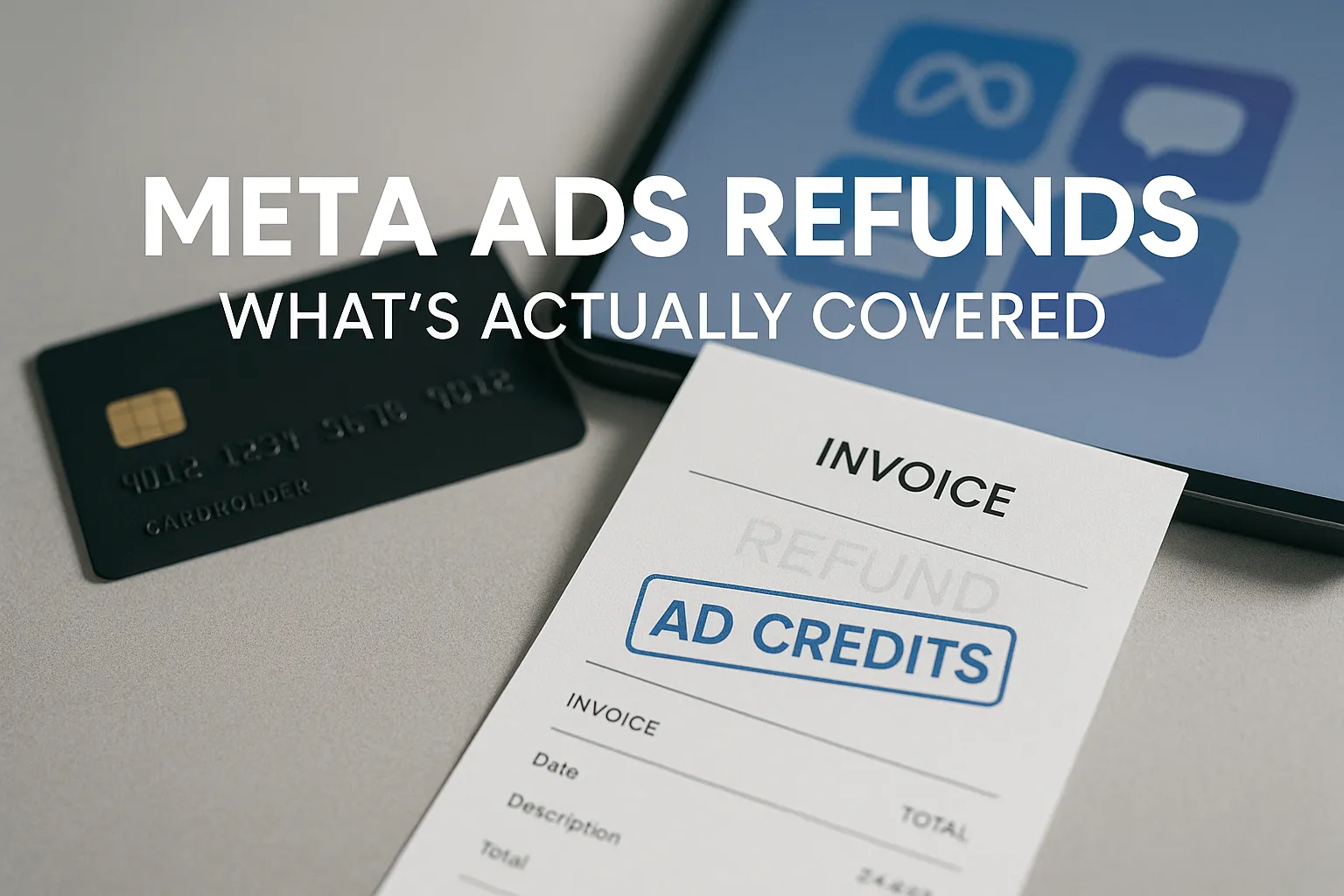
Meta explains that any refund for ads on Facebook, Instagram, or Messenger is at Meta’s sole discretion and evaluated case‑by‑case. Critically, Meta states it does not issue refunds for poor ad performance or return on investment. In situations where a refund is approved, Meta may issue it as ad credits; if you use monthly invoicing, credit memos can apply against future spend.

When a refund claim might make sense

Unauthorized activity can be considered, but it isn’t automatically refundable. Meta’s Self-serve Ad Terms state you’re responsible for orders placed through your ad account, so hacked-spend refunds remain discretionary and hinge on evidence and support review. For example, after a widely reported delivery glitch in April 2023, Meta moved to compensate affected advertisers, though fulfillment timelines varied. If you suspect unauthorized activity, review your Billing section and support inbox, capture evidence, and contact support promptly.
How to submit a refund/dispute (practical steps)

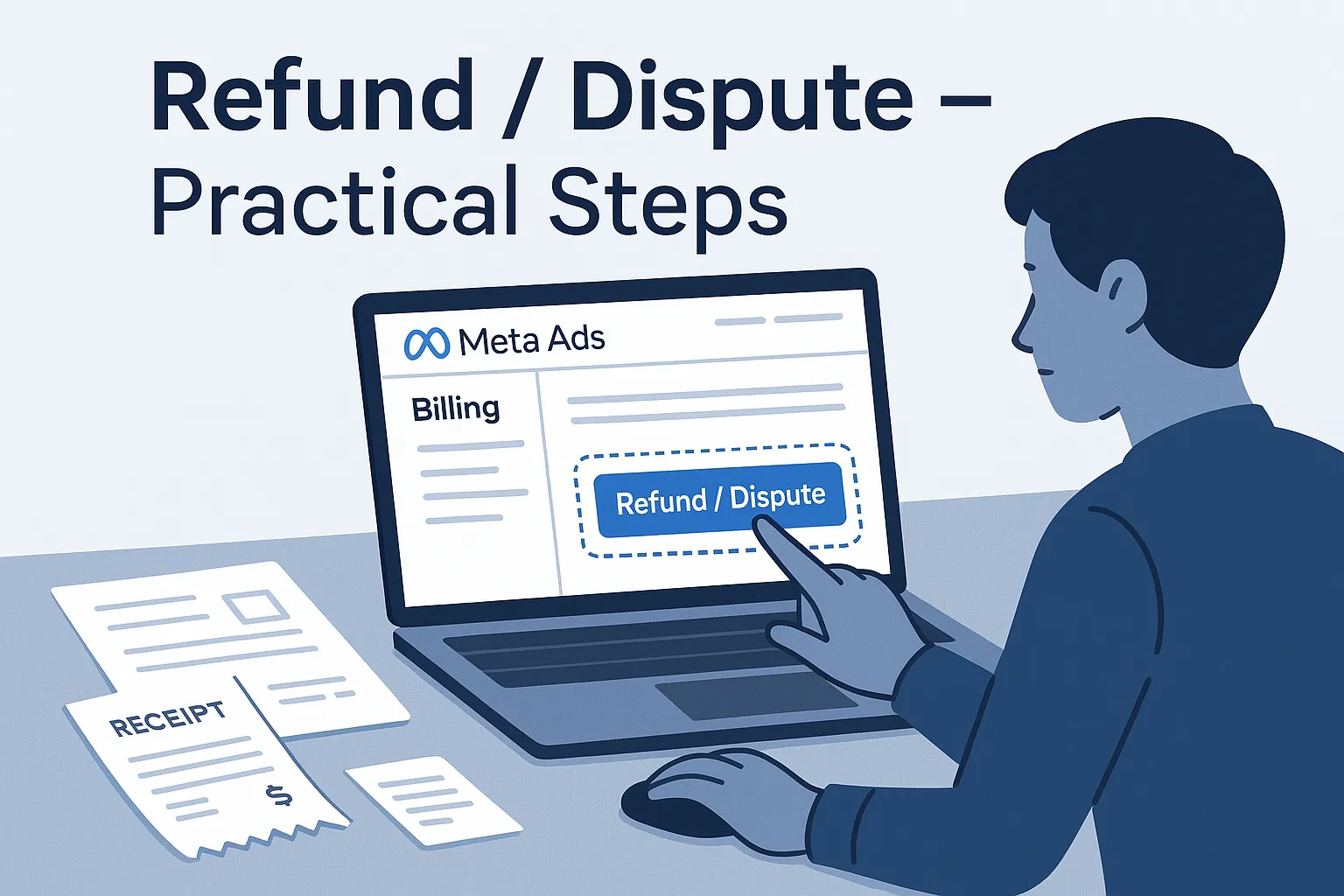
  1. Go to Ads Manager → Billing & Payments to review transactions and receipts. Identify the charge you want to dispute.
  2. Open a billing ticket from within Business Help Center/Support. Provide precise facts: transaction IDs, campaign/ad IDs, timestamps, and receipts.
  3. Attach evidence of platform error or unauthorized use (screenshots, logs, invoices).
  4. Watch your Support Inbox for updates and respond quickly to information requests.
  5. Know the outcome forms: payment-method refunds (where possible), ad credits, or credit memos for monthly invoicing.

Reality check: Refunds for “bad results” almost never succeed under Meta’s policy. The more your claim hinges on objective billing/technical evidence, the better your odds.
Why prevention beats refunds (especially on Meta)

Invalid traffic (IVT)—bots, click farms, data‑center traffic—and fake leads waste budget and poison campaign learning. According to Spider AF’s 2025 Ad Fraud White Paper, around 5.1% of clicks were fraudulent in 2024 (JP market analysis), and valid vs. invalid clicks showed roughly a 2x CVR gap—meaning cleanup directly improves conversion efficiency. Globally, estimated ad‑fraud losses reached $37.7B in 2024 and are projected to grow further in 2025.
The better strategy: block IVT and fake leads before they drain spend

  • Spider AF PPC Protection detects and blocks bots/invalid traffic in real time across major platforms, including Meta.
  • For Meta specifically, Spider AF supports audience exclusion: users flagged as invalid are automatically fed to exclusion lists so they stop seeing your ads. Lists are updated continuously.
  • Fake Lead Protection filters junk sign‑ups before they hit your CRM, protecting ROAS and sales focus.
  • SiteScan monitors client‑side scripts for tampering/malware that can break forms or leak data—issues that silently inflate spend and degrade attribution quality.

Frequently asked questions

Does Meta refund for “fake clicks” or low‑quality traffic?

Not for performance dissatisfaction. Meta’s policy explicitly says refunds aren’t given for poor results or ROI. Focus on preventing IVT so you don’t pay for it in the first place.

Will I get cash back or ad credits?

It depends. Meta may refund to your payment method, but if that isn’t possible you may receive ad credits; monthly‑invoiced accounts may receive credit memos.

Are there examples of Meta compensating advertisers?

Yes, for incident‑level glitches/outages Meta has compensated accounts, though the form and timeline vary.

Bottom line

Meta rarely refunds ad spend, especially when the complaint is simply “results were bad.” Even when granted, compensation may come as ad credits, not cash. The faster, more reliable ROI play is to stop invalid clicks and fake leads before they hit your budgets and models. If you run Meta ads, put prevention in place now:

FREE SCAN

See your account's invalid traffic in 24 hours.

Spider AF will quantify exactly how much of your last 30 days of paid spend went to bots and click farms.

No credit card
1-line install
Cancel any time
Or book a 20-min demo
FAQ

People also ask.

Q 01 Are click farms illegal? +
In most jurisdictions, click farms violate ad-network terms of service and consumer-protection laws — but enforcement is patchy and cross-border. The FTC has taken action against fake-engagement operations, and Japan's METI has issued guidance treating fake reviews and bot traffic as deceptive practices. The practical reality: legal action is slow; technical blocking is fast.
Q 02 How is a click farm different from a botnet? +
Click farms typically use real humans (or human-supervised devices) to evade behavioral detection — they pass CAPTCHAs, mimic mouse movement, even simulate purchase journeys. Botnets are fully automated and easier to fingerprint. Modern fraud usually blends both: bots for volume, human "supervisors" for the high-value clicks.
Q 03 Can Google Ads or Meta detect click farms on their own? +
Both networks credit obviously-invalid clicks, but their detection runs on aggregated, post-hoc statistical signals — they refund days or weeks later. By then, your bidding algorithms have already optimized toward the polluted data. Independent, real-time detection at the click layer is what closes the loop.
Q 04 Will blocking click-farm traffic hurt my reach? +
No. Blocking invalid clicks only removes traffic that was never going to convert. The downstream effect is usually the opposite — your bidding model gets cleaner training signal and starts spending more on audiences that actually convert.
Q 05 How fast can Spider AF block click-farm traffic? +
Sub-200ms detection at the click event, with auto-sync to Google, Meta, TikTok, and Microsoft exclusion lists in seconds. Most accounts see meaningful blocking within 24 hours of installing the tag.

Meta Ads Refund Policy: Why Refunds Are Rare—and How to Avoid Needing One

Table of Contents

Meta reviews ad refund requests case‑by‑case and does not refund for poor ad performance or ROI. If a refund is granted, it may be issued as ad credits rather than cash, and monthly‑invoiced accounts may receive credit memos. The practical path is prevention: block invalid traffic and fake leads so you don’t need to file claims in the first place.

PPC Protection (Spider AF) — free trial: https://spideraf.com/ppc-protection

What Meta’s refund policy actually says

Meta explains that any refund for ads on Facebook, Instagram, or Messenger is at Meta’s sole discretion and evaluated case‑by‑case. Critically, Meta states it does not issue refunds for poor ad performance or return on investment. In situations where a refund is approved, Meta may issue it as ad credits; if you use monthly invoicing, credit memos can apply against future spend.

When a refund claim might make sense

Unauthorized activity can be considered, but it isn’t automatically refundable. Meta’s Self-serve Ad Terms state you’re responsible for orders placed through your ad account, so hacked-spend refunds remain discretionary and hinge on evidence and support review. For example, after a widely reported delivery glitch in April 2023, Meta moved to compensate affected advertisers, though fulfillment timelines varied. If you suspect unauthorized activity, review your Billing section and support inbox, capture evidence, and contact support promptly.

How to submit a refund/dispute (practical steps)

  1. Go to Ads Manager → Billing & Payments to review transactions and receipts. Identify the charge you want to dispute.
  2. Open a billing ticket from within Business Help Center/Support. Provide precise facts: transaction IDs, campaign/ad IDs, timestamps, and receipts.
  3. Attach evidence of platform error or unauthorized use (screenshots, logs, invoices).
  4. Watch your Support Inbox for updates and respond quickly to information requests.
  5. Know the outcome forms: payment-method refunds (where possible), ad credits, or credit memos for monthly invoicing.

Reality check: Refunds for “bad results” almost never succeed under Meta’s policy. The more your claim hinges on objective billing/technical evidence, the better your odds.

Why prevention beats refunds (especially on Meta)

Invalid traffic (IVT)—bots, click farms, data‑center traffic—and fake leads waste budget and poison campaign learning. According to Spider AF’s 2025 Ad Fraud White Paper, around 5.1% of clicks were fraudulent in 2024 (JP market analysis), and valid vs. invalid clicks showed roughly a 2x CVR gap—meaning cleanup directly improves conversion efficiency. Globally, estimated ad‑fraud losses reached $37.7B in 2024 and are projected to grow further in 2025.

The better strategy: block IVT and fake leads before they drain spend

  • Spider AF PPC Protection detects and blocks bots/invalid traffic in real time across major platforms, including Meta.
  • For Meta specifically, Spider AF supports audience exclusion: users flagged as invalid are automatically fed to exclusion lists so they stop seeing your ads. Lists are updated continuously.
  • Fake Lead Protection filters junk sign‑ups before they hit your CRM, protecting ROAS and sales focus.
  • SiteScan monitors client‑side scripts for tampering/malware that can break forms or leak data—issues that silently inflate spend and degrade attribution quality.

Frequently asked questions

Does Meta refund for “fake clicks” or low‑quality traffic?

Not for performance dissatisfaction. Meta’s policy explicitly says refunds aren’t given for poor results or ROI. Focus on preventing IVT so you don’t pay for it in the first place.

Will I get cash back or ad credits?

It depends. Meta may refund to your payment method, but if that isn’t possible you may receive ad credits; monthly‑invoiced accounts may receive credit memos.

Are there examples of Meta compensating advertisers?

Yes, for incident‑level glitches/outages Meta has compensated accounts, though the form and timeline vary.

Bottom line

Meta rarely refunds ad spend, especially when the complaint is simply “results were bad.” Even when granted, compensation may come as ad credits, not cash. The faster, more reliable ROI play is to stop invalid clicks and fake leads before they hit your budgets and models. If you run Meta ads, put prevention in place now:

SpiderAF
アドフラウド
Spider Labs