


The impact of anti-ad fraud solutions for established market listed groups and rapidly growing digital marketing agencies.
Digital Identity, a company listed on the stock exchange seven years after its founding, provides a wide range of digital marketing strategies and advertising operations.
Since they were featured on TV several years ago, inquiries from customers about anti-ad fraud measures have increased. As a result of the growth of their customers' businesses and support for overall digital marketing, the company had to consider their internal policy for advertising fraud.
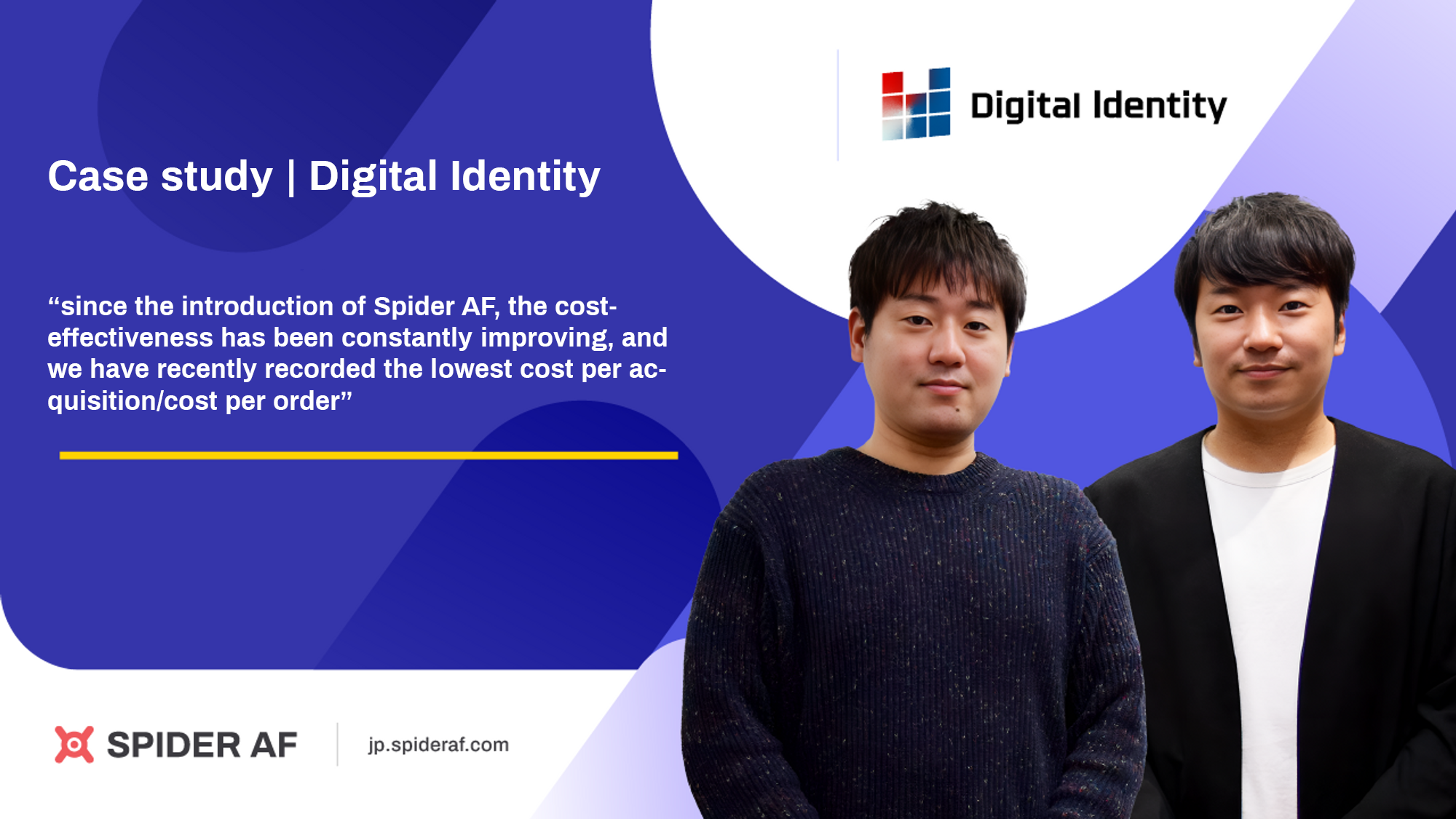
Senior Manager of the Consulting Division, Mr. Sano, and Chief Consultant, Mr. Nose, shared their thoughts on their measures against ad fraud, which has been receiving more and more inquiries recently.
“Ad Fraud Discussion Reignites with Launch of the Japan Institute for Certification of Digital Advertising Quality (JICDAQ)”
When did your company start considering ad fraud prevention measures?
Mr. Sano: We had been discussing ad fraud prevention measures within the company for about five years. Given that our company's founding service is in the field of advertising operations, we have been aware of the term "ad fraud" for quite some time.
However, once the problem was aired on TV, we understood the real situation, and at the same time, inquiries from some customers increased. However, during that time only a few tools could take measures, and provide solutions with small costs and higher transparency. As a result, we did not actively introduce them because the cost of countermeasures and the actual improvement of advertising effects were not balanced.
Some national clients have implemented them, but rather than automating the process,their solutions were based on a manual operation of creating a blacklist and blocking it. Also, at that time, the problems with ad networks were strong.
There was a time when you were considering measures against ad fraud even before that! How is the situation these days?
Mr. Sano: Recently, with the establishment of JICDAQ, ad verification has become a topic of interest. The frequency of inquiries has increased, and I think that the base of companies interested in our products has expanded.
However, the cost of ad fraud prevention solutions are high, especially for alternative ad solution providers. I get the impression that many advertisers are hesitant to introduce them. With this in mind, the entry price of Spider AF is very cheap and easy to introduce, so it is easy to propose to marketers within the company. While ad fraud solutions have dashboards, I think it is a tool that sometimes is difficult to visualize the cost-effectiveness and cost savings.
Luckily, Spider AF does a pretty good job doing it. Therefore, if you introduce a solution that is too expensive to a customer, it will look like you are selling the tool. There were some aspects that were slightly different from our company's stance of accompanying customers through comprehensive sales processes.
Ad fraud prevention measures established as an infrastructure tool.
I'm happy to hear that! By the way, we are delighted to work with more and more of your client companies. How has business progressed?
Mr. Nose: It has been less than a year since Spider AFs introduction, so it is already part of our infrastructure for advertising operations. At that time, we had a problem where the cost per click was high, so we decided to introduce it.
Of course, we are implementing other operational improvement measures in parallel, but since the introduction, the cost-effectiveness has been constantly improving, and we have recently recorded the lowest cost per acquisition/cost per order. I think that one of the factors is Spider AF.
Thank you! How do you find using Spider AF on a daily basis?
Mr. Nose: Since we have established this solution as part of our products and services, it is now closer to playing a role like insurance. As we knew from the initial trial, the cost-effectiveness of the solution for blocking fraudulent clicks is still very high. In addition, since it automatically blocks ad fraud, it is also helpful that there is no need to increase the number of man-hours for managing the solution.
Countermeasures for ad fraud that all parties involved in ad distribution should be aware of
Thank you for sharing your thoughts on your current business. In light of this, what is your company's current position on ad fraud countermeasures?
Mr. Sano: First and foremost, regarding our perspective on ad fraud, we believe that it will not be eradicated completely. This is due to the pay-per-click and pay-for-impression mechanisms of internet advertising, which makes it difficult to prevent people from clicking on ads.
Initially, we recognized that ad networks were problematic, and it was up to the advertising media to take proactive measures against them. Currently, we see that the media is taking significant steps in dealing with ad fraud. In the past, some media outlets were exposed to unreputable distribution sides, but now such issues are being addressed and minimized.
In the past, ad fraud countermeasures involved multiple parties such as ad networks, advertisers, and ad agencies like us. However, the primary party to take measures has become clear, which was not always the case before.
With solutions like Spider AF, advertisers and advertising agencies can take measures against ad fraud independently, without relying on the response of ad networks or if there is a shortage of support. It has become a favorable environment to proactively and easily take measures against ad fraud, including the technical aspect.
Also, from the perspective of an ad agency, ad fraud has been a persistent problem since the inception of internet advertising, and it will continue to exist. Therefore, it is essential to remain aware that the best practices for countermeasures will change.
What are the advantages of using Spider AF as an ad fraud solution for your company?
Mr. Sano: The most significant advantage is its low entry cost. With the exception of some national clients, internet advertising is still a performance-oriented operation. As a result, we would like to take measures against ad fraud, but there are instances when both advertisers and agencies hesitate to implement these measures. However, Spider AF offers a free diagnosis and provides transparency regarding costs, making it easy to implement.
Mr. Nose: One of the benefits is that it requires minimal man-hours for operation. Our consultants provide comprehensive support for digital marketing, and ad fraud countermeasures are not always a top priority. In such cases, it would be challenging to implement a tool that requires extensive manual operation. However, Spider AF is a tool that covers the operation with a certain degree of automation, making it incredibly simple to manage.
Mr. Sano: Currently, as previously mentioned, the media is actively taking countermeasures. However, the strengths and weaknesses of these measures will vary for each medium. In addition, the measures themselves will be implemented without notice, making it difficult to keep up with the ever-changing countermeasures. As a result, we believe that the importance of using tools for visualization will increase in the future.
Thank you for this interview!


%20ENJAL-banner(NEW).png)
%2520ENJAL-banner(NEW)%2520(2).png)