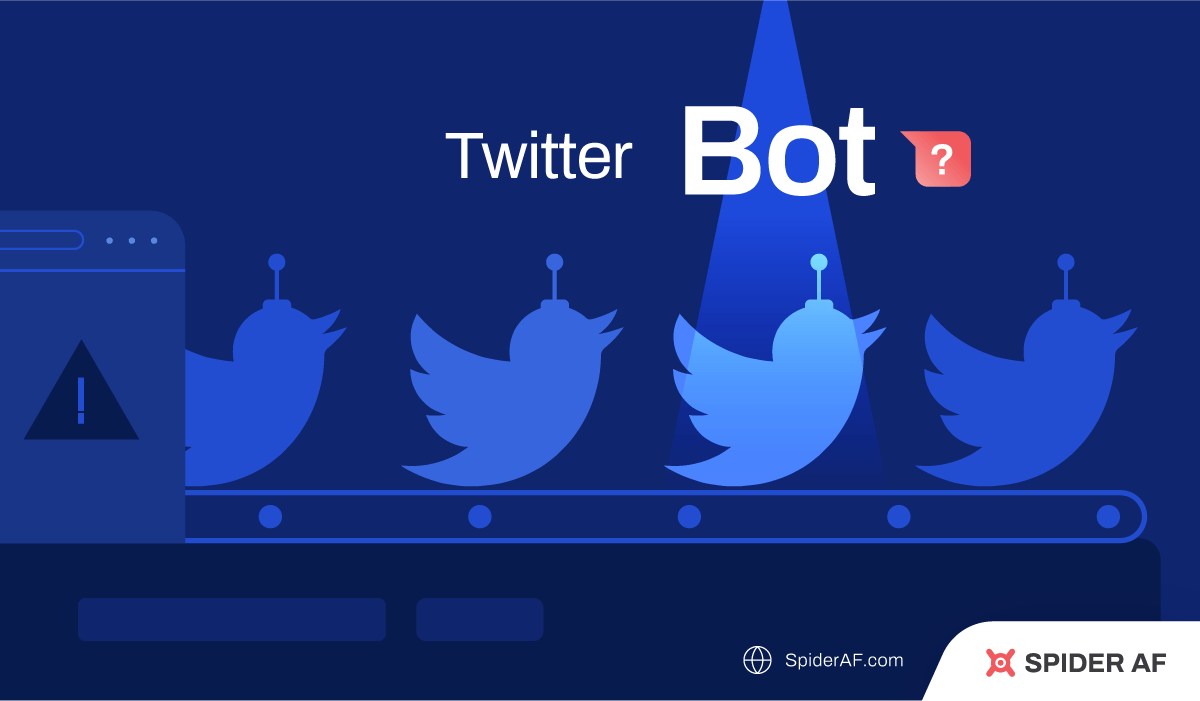
Bots make up roughly 15% of Twitter — and they're not all bad, but the ones that are can silently drain your ad budget and warp your metrics. This deep dive breaks down how to spot the difference, what Twitter is actually doing about it, and what your business should be doing too.
Twitter bots are automated accounts on X (formerly Twitter) that mimic human behavior — liking, retweeting, following, and clicking ads — without any real person behind the keyboard. While some bots perform useful tasks, malicious twitter bots cost advertisers billions each year and pollute platform data that businesses rely on.
This guide covers everything businesses need to know in 2026: how twitter bots work, how to identify them, how the problem extends across social media platforms, and how to protect your ad budget against bot-driven fraud.
Twitter bots (also called X bots) are software programs that use X's API to post content, interact with other accounts, and simulate real user behavior automatically. They range from genuinely helpful automation tools to sophisticated fraud machines designed to steal ad budgets and manipulate public discourse.
Bots are not a new phenomenon — automated accounts have existed since Twitter's early days — but the scale has grown dramatically. X's own disclosures have estimated that up to 5% of monetizable daily active users (mDAUs) are bots, though independent researchers from Stanford Internet Observatory and Carnegie Mellon University have consistently found higher figures, suggesting 9–15% of active accounts show automated behavior patterns. (Spider AF Ad Fraud Report 2026)
Not all bots are malicious. Understanding the distinction is essential for businesses:
Twitter bots operate through X's official API (application programming interface) or, in more sophisticated cases, through unofficial browser automation tools that bypass API rate limits. The basic workflow looks like this:
For advertisers, the most harmful behavior is the final step: clicking on promoted ads without genuine purchase intent. This action — known as click fraud (invalid ad clicks that drain budgets) — generates a real cost in the advertiser's account while delivering zero business value. Each fraudulent click on a promoted tweet charges the advertiser while delivering nothing.
Individual bots cause limited damage. The real threat comes from bot networks — collections of hundreds or thousands of coordinated accounts acting in concert. Bot networks can:
According to research published by the Oxford Internet Institute, coordinated bot activity has been identified in political campaigns across over 70 countries — demonstrating the global scale of organized bot operations. (Oxford Internet Institute, Computational Propaganda Project)

For businesses running paid campaigns on X, bots represent a direct financial threat. Invalid clicks from bots inflate cost-per-click (CPC) costs, distort campaign performance data, and cause advertisers to scale budgets based on false positive signals.
Ad fraud (invalid traffic that wastes ad spend) caused or amplified by bot activity includes:
Spider AF's proprietary data shows that ad fraud costs businesses globally $32.6 billion per year. Social media platforms — including X, Meta, and TikTok — collectively account for a growing share of this total as bot operators follow advertiser budgets onto these platforms. (Spider AF Ad Fraud Report 2026)
Beyond direct spend waste, bots corrupt the data that marketers use to make decisions:
The twitter bot problem is part of a wider social media ad fraud crisis. Advertisers who switch from X to Meta or TikTok to "escape" bot activity often discover the problem follows their budget. Each major platform has its own bot ecosystem:
Research from the University of Southern California estimated that on Meta platforms, fake accounts and bots represent roughly 11–13% of user accounts globally — a figure Meta itself has acknowledged in regulatory filings. (Meta Q1 2023 earnings disclosure)
For TikTok advertisers, independent audits by ad verification firms consistently flag elevated invalid traffic rates on in-feed ads, particularly in performance campaigns targeting app installs and website conversions. The common denominator across all platforms: bot operators follow advertiser money, and social media ad budgets are an increasingly attractive target.
This is why businesses that rely solely on platform-level bot filtering remain exposed. Platform defenses are primarily designed to protect user experience, not to compensate advertisers for every invalid click. Third-party fraud detection — sitting between the ad platform and your campaigns — provides an independent verification layer that platforms cannot offer themselves.
Identifying bot accounts helps users and businesses avoid wasting engagement budget on fake audiences and stay alert to manipulation. Here are the most reliable signals:
X (formerly Twitter) has implemented several measures to address bot activity since the platform's acquisition and restructuring under Elon Musk in 2022:
X employs machine learning models to identify suspicious behavioral patterns — including rapid posting, coordinated activity, and API misuse — and suspends accounts that violate its platform manipulation policies. The platform reported suspending more than 1 million accounts per day at peak periods during bot purge operations in 2023.
X's detection algorithms assess multiple signals:
In 2022, X introduced automated account labels that display a robot icon and information about a bot account's purpose. Operators of legitimate bots can apply for this label, helping users distinguish helpful automation (weather bots, news feeds) from malicious actors. This transparency measure helps users make informed decisions about which accounts to engage with and trust.
X significantly restricted access to its API starting in 2023, requiring developers to pay for higher-tier access tiers. This change was explicitly aimed at making large-scale bot operation more expensive and more traceable. While controversial among legitimate developers, the policy has materially increased the cost barrier for bot farm operators.
Despite these efforts, the cat-and-mouse game between X's detection systems and sophisticated bot operators continues. Platform-level defenses are necessary but not sufficient for advertisers who need to protect their budgets from invalid traffic that reaches their campaigns.
Waiting for X — or any social platform — to solve the bot problem on your behalf is a commercially risky strategy. Advertisers who take proactive steps to detect and filter invalid traffic consistently recover meaningful budget that platform-level filtering misses.
Before you can protect your budget, you need to understand your current exposure. Key metrics to analyze:
Platform-provided analytics cannot objectively measure their own invalid traffic — they have a commercial incentive to report clean traffic. A third-party ad fraud detection solution like Spider AF sits independently of the platform, analyzing traffic patterns in real time and blocking invalid clicks before they cost you money.
Spider AF's detection covers:
If you run influencer campaigns on X or Instagram, conduct an audience quality audit before committing budget. High follower counts mean nothing if a large portion of those followers are bots. Legitimate influencer vetting should include:
The most extensively documented example of large-scale Twitter bot manipulation occurred during the 2016 US Presidential Election. Research from Oxford Internet Institute and USC found that approximately 19% of all election-related tweets during the period studied were generated by bots — a volume sufficient to influence trending topics and create the false impression of organic public sentiment.
This case established a template that has been replicated globally: bot networks are deployed to amplify fringe content, generate artificial social proof for certain positions, and suppress opposing viewpoints through mass reporting. For businesses, the lesson is that the engagement metrics platforms report are vulnerable to coordinated manipulation at scale.
A 2023 analysis by the influencer marketing industry found that between 10–25% of "followers" on large social accounts across platforms showed bot-like characteristics. For brands paying premium rates for sponsored content based on follower counts and engagement rates, this represents direct budget waste — paying for reach that never delivers to real consumers.
Customer service automation is a legitimate use case that demonstrates bots can provide genuine value when deployed ethically. Businesses like airlines and telecommunications companies use X bots to handle high volumes of customer inquiries, reducing response times from hours to minutes. The key differentiator: these bots are labeled, transparent about their automated nature, and add measurable value for users.
Twitter bots (X bots) are not inherently illegal. X's developer policies permit legitimate automation — customer service bots, news feed bots, and utility bots are all allowed as long as they comply with platform rules. What is prohibited — and in some jurisdictions legally actionable — is using bots for platform manipulation, ad fraud, vote manipulation, or coordinated inauthentic behavior. Using bots to generate fraudulent ad clicks may also constitute fraud under applicable laws in the US, EU, and other jurisdictions.
Estimates vary by methodology. X (formerly Twitter) has disclosed in regulatory filings that approximately 5% of monetizable daily active users may be bots. Independent researchers from Stanford, CMU, and Oxford have found higher figures — typically estimating that 9–15% of active accounts show significant automated behavior. The discrepancy exists because platform estimates use narrower definitions and measure only accounts included in advertising reach calculations, while academic studies measure the full active account population.
The high volume of bots on X exists because automation is cheap to operate, advertising targets generate real financial returns for fraud operators, and platform enforcement — while improving — cannot keep pace with bot operator tactics. Bot farms can generate revenue by selling fake followers, selling click fraud as a service to competitors, inflating engagement to trigger higher influencer fees, and manipulating trending topics for political or commercial purposes.
Twitter bots affect advertisers through invalid clicks on promoted tweets (charged to the advertiser's account), inflated engagement metrics that create misleading campaign performance data, corrupted audience data that skews targeting optimization, and follower fraud that inflates influencer pricing. Spider AF data indicates that social media ad fraud on social platforms is a growing share of the global $32.6 billion ad fraud total.
Yes — several behavioral and profile signals indicate bot accounts: abnormally high posting frequency (50+ posts per day), an extreme following-to-follower ratio, accounts created in bulk during the same period, generic or absent profile photos, username strings with random number sequences, instant automated replies, and posting at all hours without natural human activity patterns. For advertising fraud detection purposes, these manual signals are supplemented by automated detection tools that analyze traffic patterns at scale.
Spider AF's ad fraud detection platform integrates with X Ads, Google Ads, Meta Ads, and other major platforms to identify and block invalid traffic before it costs advertisers money. Using device fingerprinting, behavioral analysis, IP reputation scoring, and real-time blocking, Spider AF gives advertisers an independent verification layer that sits outside the platforms themselves. Advertisers using Spider AF typically recover 10–30% of social media ad spend previously lost to invalid traffic. Start a free analysis here.
Twitter bots represent both a useful automation capability and one of the most costly problems in digital advertising. For businesses spending on X Ads and broader social media campaigns, the key points to act on are:
Last updated: June 2026

MFA growth, AI-driven fraud risks, and how top advertisers are protecting their budgets. Free PDF!


.png)