Spider AF /
Resources /
Articles /
Referral Click Fraud: What It Is, Why It Happens, and How to Stop It
No items found.
September 4, 2025

Referral Click Fraud: What It Is, Why It Happens, and How to Stop It

In this article

01
What is a click farm?
01
What is a click farm?
01
What is a click farm?
01
What is a click farm?
01
What is a click farm?
Quick take · 30-second version

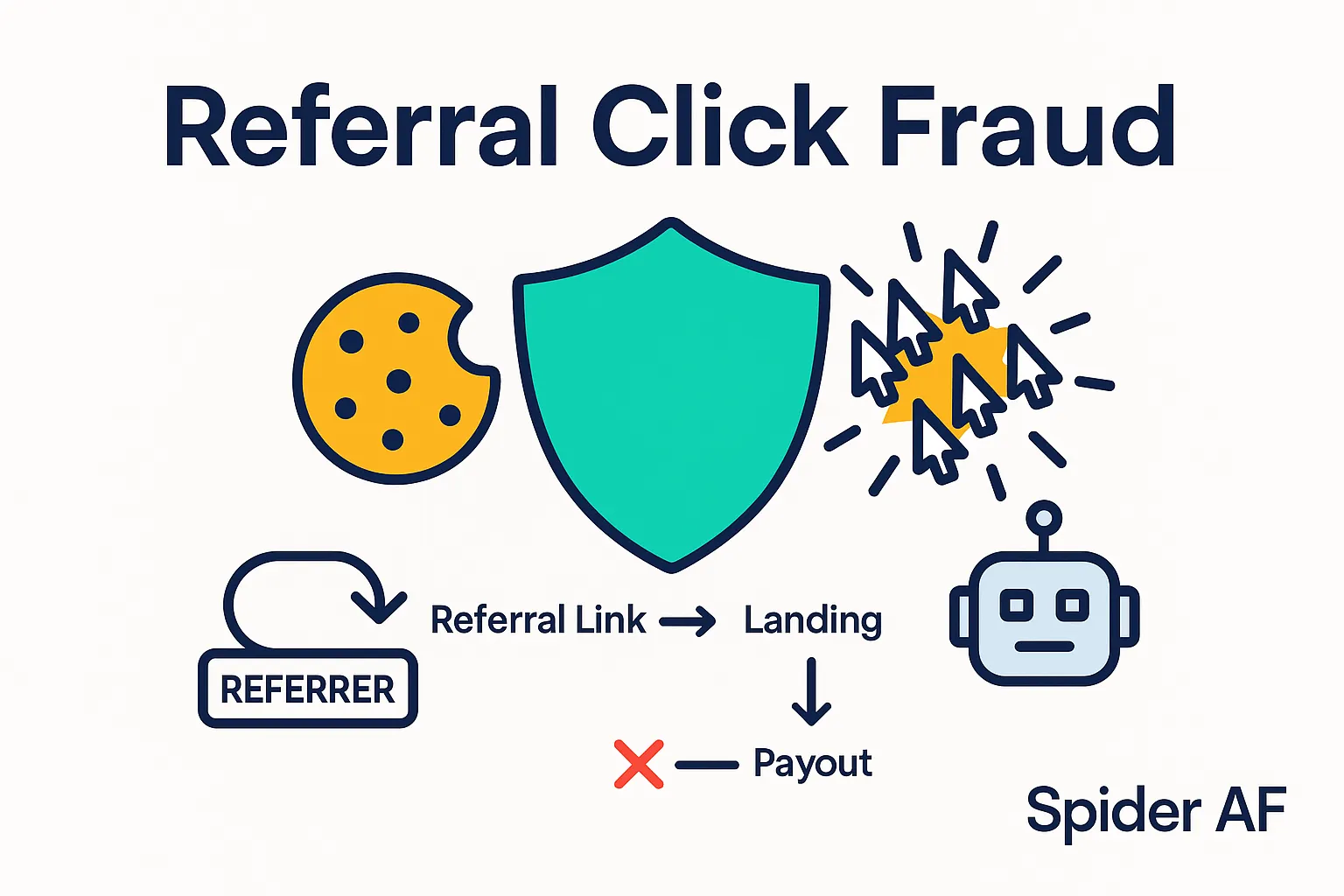
Referral click fraud is the manipulation of referral or affiliate clicks to steal credit and payouts that weren’t earned. It shows up as mysterious spikes in referral traffic, cookie-based attributions that don’t match user behavior, and “conversions” that never become customers. Left unchecked, it distorts your analytics, drains ad and partner budgets, and trains auto-optimizing platforms to double down on junk. This guide explains how referral click fraud works across affiliate and referral programs, the data patterns that reveal it, and a practical playbook to prevent it—plus where Spider AF fits in to block bad traffic and clean up your attribution.

What is referral click fraud?

Referral click fraud is any attempt to fabricate or hijack referral attributions so a fraudster gets paid when they didn’t truly refer a user. Common forms include the following.

Cookie stuffing (cookie dropping)

Secretly placing affiliate cookies so future sales are credited to the stuffer rather than the genuine source.

Click spamming or click flooding

Blasting fake clicks so that, by chance, some real conversions are attributed to the spammer. This is common in mobile and applies to web referrals as well.

Self-referrals and looped attributions

Engineering flows where users are forced through pages that rewrite the referrer, or injecting scripts that alter tracking.

Bot-initiated referrals

Automated sessions that appear to come from partner links but never engage like real users.

Where this sits in industry standards

Standards groups classify these behaviors as Invalid Traffic (IVT), which measurement bodies should detect and filter.

Why referral click fraud hurts ROI and attribution

Fraudulent referrals don’t just waste commission—they pollute optimization signals and mislead budgeting.

Auto-optimization goes off-track

Platforms keep sending budget toward sources that “convert,” even when those conversions are fake or hijacked.

Analytics get skewed

Mixing invalid with valid traffic degrades decision-making by lowering true conversion rate and confusing source performance.

Referral and affiliate budgets get siphoned

Historic enforcement actions around cookie stuffing show just how lucrative this abuse can be for bad actors.

How to spot referral click fraud (fast)

Look for patterns that don’t fit genuine behavior.

Attribution anomalies

Watch for sudden jumps in referral credit without matching engagement, last-click credits that override true discovery sources, or unusual geo/device mixes at odd hours.

Cookie and referrer red flags

Users accumulating affiliate cookies without visible clicks, several referrers firing within milliseconds, or hidden redirects before landing pages.

Quality and lead integrity

Lower conversion rates from referral cohorts, inflated new-user counts that never repurchase, or CRM-returned bounces and unreachable leads.

Client-side tampering risk

Third-party scripts can alter forms or trackers and exfiltrate data. Continuous monitoring is now essential.

Proven prevention playbook

1) Tighten referral and affiliate guardrails

Use server-side click validation and signed parameters; reject clicks missing required tokens or with timestamp/IP mismatches. Cap attribution windows and move beyond brittle last-click models. Enforce program terms: ban toolbars, forced redirects, undisclosed incentives; require site/app whitelisting and manual reviews for new partners.

2) Block invalid clicks in real time

Scoring and blocking IVT across search, social, and display prevents spammers from planting bad cookies and stops bot-driven referrals before they reach your site.

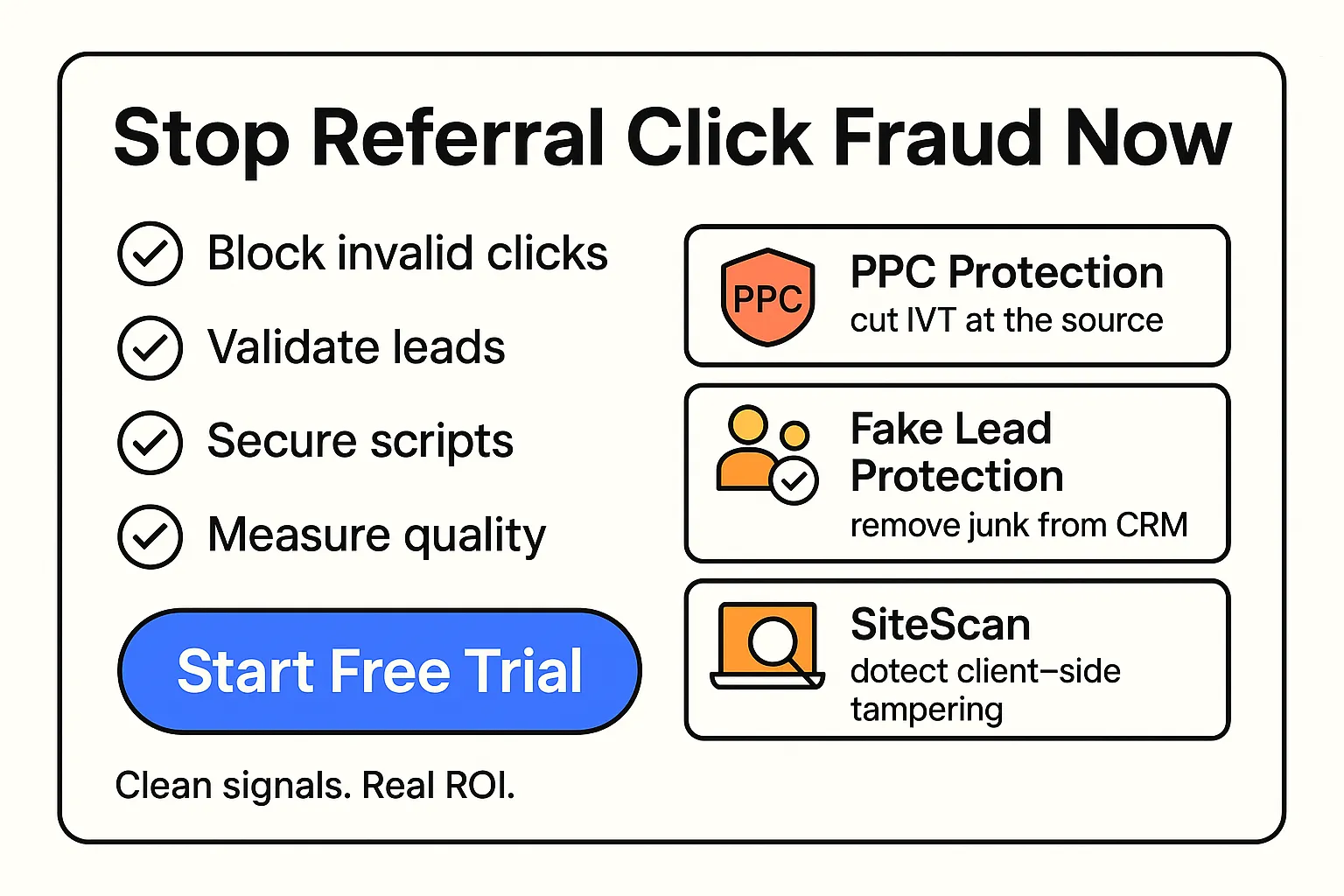
Spider AF PPC Protection

Use automated IP and audience exclusions, poor-placement filtering, and suppression of junk inventory to cut off invalid clicks across paid channels: https://spideraf.com/ppc-protection

Fake Lead Protection

Validate conversions in your CRM pipeline to remove fraudulent training data from platform optimization and keep budgets focused on real prospects: https://spideraf.com/fake-lead-protection

3) Secure the client side (stop silent cookie-dropping)

Monitor every third-party script with continuous inventory, whitelisting, tamper detection, and anomaly alerts for unauthorized data transmissions or injected tags.

Spider AF SiteScan

Detect script changes and risky behaviors that enable cookie stuffing or referrer manipulation: https://spideraf.com/sitescan

4) Investigate with the right KPIs

Track referral CTR to engaged sessions to qualified leads to revenue, not just sign-ups. Segment by partner, placement, creative, geo, and device, then compare quality metrics such as AOV, refund rate, chargebacks, and LTV. Benchmark IVT share and fake-lead rates to spot outliers quickly.
Frequently asked questions

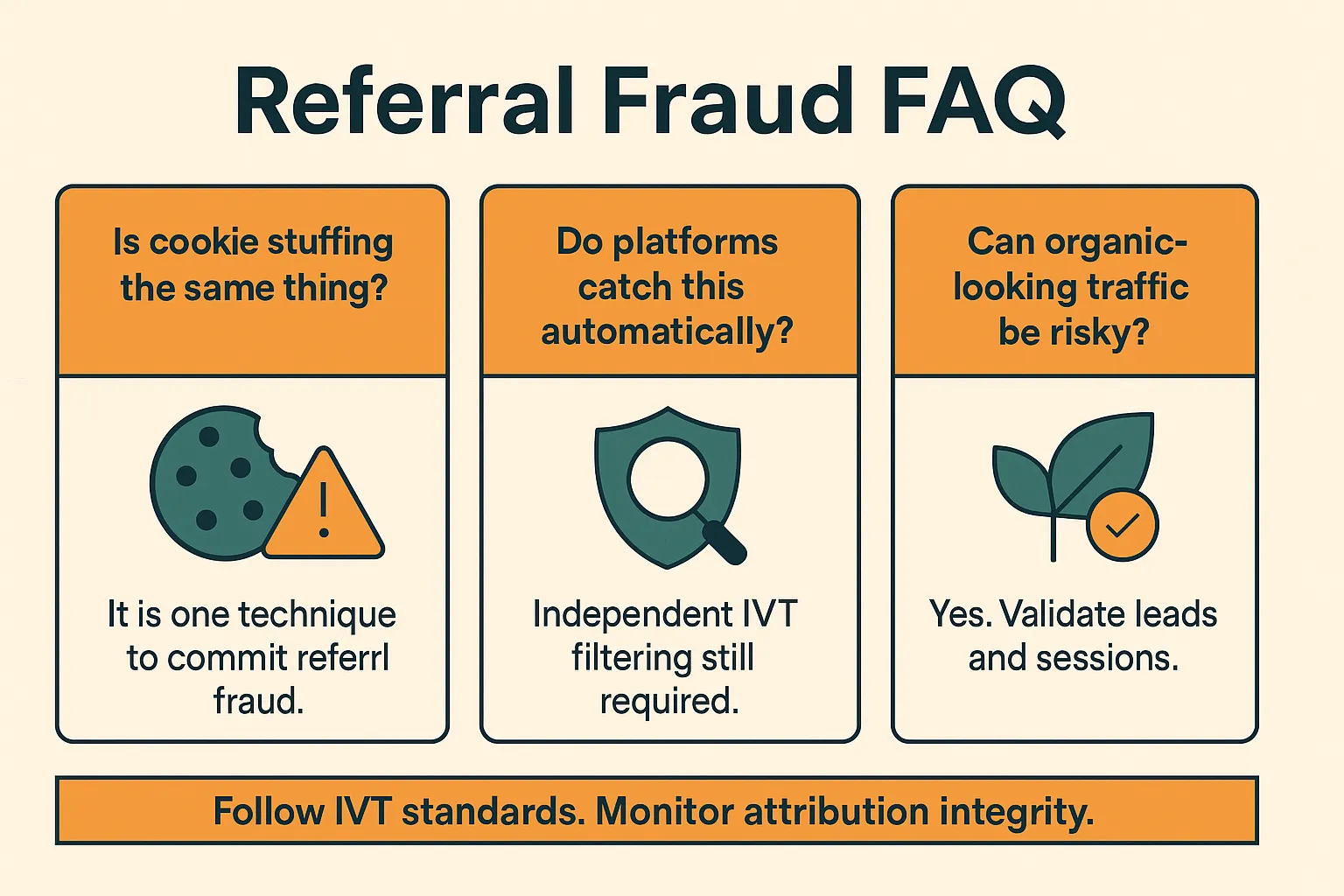
Is cookie stuffing the same as referral click fraud?

Cookie stuffing is one major technique used to commit referral or affiliate fraud by forcing attribution without a real click.

Do platforms catch this automatically?

They try, but independent IVT detection and filtration remain necessary because abuse evolves quickly.

Can organic-looking traffic be risky?

Yes. Fraudsters often mimic organic paths, so you must harden forms and validation—not only paid channels.
Conclusion

Referral click fraud thrives in the gaps between tracking, policy, and security. Close those gaps to recover budget, restore clean signals, and ensure partners get credit only when they truly earn it.

Start with the protection that matches your biggest exposure and expand from there.

Try Spider AF to block referral click fraud before it hits your budget.

FREE SCAN

See your account's invalid traffic in 24 hours.

Spider AF will quantify exactly how much of your last 30 days of paid spend went to bots and click farms.

No credit card
1-line install
Cancel any time
Or book a 20-min demo
FAQ

People also ask.

Q 01 Are click farms illegal? +
In most jurisdictions, click farms violate ad-network terms of service and consumer-protection laws — but enforcement is patchy and cross-border. The FTC has taken action against fake-engagement operations, and Japan's METI has issued guidance treating fake reviews and bot traffic as deceptive practices. The practical reality: legal action is slow; technical blocking is fast.
Q 02 How is a click farm different from a botnet? +
Click farms typically use real humans (or human-supervised devices) to evade behavioral detection — they pass CAPTCHAs, mimic mouse movement, even simulate purchase journeys. Botnets are fully automated and easier to fingerprint. Modern fraud usually blends both: bots for volume, human "supervisors" for the high-value clicks.
Q 03 Can Google Ads or Meta detect click farms on their own? +
Both networks credit obviously-invalid clicks, but their detection runs on aggregated, post-hoc statistical signals — they refund days or weeks later. By then, your bidding algorithms have already optimized toward the polluted data. Independent, real-time detection at the click layer is what closes the loop.
Q 04 Will blocking click-farm traffic hurt my reach? +
No. Blocking invalid clicks only removes traffic that was never going to convert. The downstream effect is usually the opposite — your bidding model gets cleaner training signal and starts spending more on audiences that actually convert.
Q 05 How fast can Spider AF block click-farm traffic? +
Sub-200ms detection at the click event, with auto-sync to Google, Meta, TikTok, and Microsoft exclusion lists in seconds. Most accounts see meaningful blocking within 24 hours of installing the tag.

Referral Click Fraud: What It Is, Why It Happens, and How to Stop It

Table of Contents

Referral click fraud is the manipulation of referral or affiliate clicks to steal credit and payouts that weren’t earned. It shows up as mysterious spikes in referral traffic, cookie-based attributions that don’t match user behavior, and “conversions” that never become customers. Left unchecked, it distorts your analytics, drains ad and partner budgets, and trains auto-optimizing platforms to double down on junk. This guide explains how referral click fraud works across affiliate and referral programs, the data patterns that reveal it, and a practical playbook to prevent it—plus where Spider AF fits in to block bad traffic and clean up your attribution.

What is referral click fraud?

Referral click fraud is any attempt to fabricate or hijack referral attributions so a fraudster gets paid when they didn’t truly refer a user. Common forms include the following.

Cookie stuffing (cookie dropping)

Secretly placing affiliate cookies so future sales are credited to the stuffer rather than the genuine source.

Click spamming or click flooding

Blasting fake clicks so that, by chance, some real conversions are attributed to the spammer. This is common in mobile and applies to web referrals as well.

Self-referrals and looped attributions

Engineering flows where users are forced through pages that rewrite the referrer, or injecting scripts that alter tracking.

Bot-initiated referrals

Automated sessions that appear to come from partner links but never engage like real users.

Where this sits in industry standards

Standards groups classify these behaviors as Invalid Traffic (IVT), which measurement bodies should detect and filter.

Why referral click fraud hurts ROI and attribution

Fraudulent referrals don’t just waste commission—they pollute optimization signals and mislead budgeting.

Auto-optimization goes off-track

Platforms keep sending budget toward sources that “convert,” even when those conversions are fake or hijacked.

Analytics get skewed

Mixing invalid with valid traffic degrades decision-making by lowering true conversion rate and confusing source performance.

Referral and affiliate budgets get siphoned

Historic enforcement actions around cookie stuffing show just how lucrative this abuse can be for bad actors.

How to spot referral click fraud (fast)

Look for patterns that don’t fit genuine behavior.

Attribution anomalies

Watch for sudden jumps in referral credit without matching engagement, last-click credits that override true discovery sources, or unusual geo/device mixes at odd hours.

Cookie and referrer red flags

Users accumulating affiliate cookies without visible clicks, several referrers firing within milliseconds, or hidden redirects before landing pages.

Quality and lead integrity

Lower conversion rates from referral cohorts, inflated new-user counts that never repurchase, or CRM-returned bounces and unreachable leads.

Client-side tampering risk

Third-party scripts can alter forms or trackers and exfiltrate data. Continuous monitoring is now essential.

Proven prevention playbook

1) Tighten referral and affiliate guardrails

Use server-side click validation and signed parameters; reject clicks missing required tokens or with timestamp/IP mismatches. Cap attribution windows and move beyond brittle last-click models. Enforce program terms: ban toolbars, forced redirects, undisclosed incentives; require site/app whitelisting and manual reviews for new partners.

2) Block invalid clicks in real time

Scoring and blocking IVT across search, social, and display prevents spammers from planting bad cookies and stops bot-driven referrals before they reach your site.

Spider AF PPC Protection

Use automated IP and audience exclusions, poor-placement filtering, and suppression of junk inventory to cut off invalid clicks across paid channels: https://spideraf.com/ppc-protection

Fake Lead Protection

Validate conversions in your CRM pipeline to remove fraudulent training data from platform optimization and keep budgets focused on real prospects: https://spideraf.com/fake-lead-protection

3) Secure the client side (stop silent cookie-dropping)

Monitor every third-party script with continuous inventory, whitelisting, tamper detection, and anomaly alerts for unauthorized data transmissions or injected tags.

Spider AF SiteScan

Detect script changes and risky behaviors that enable cookie stuffing or referrer manipulation: https://spideraf.com/sitescan

4) Investigate with the right KPIs

Track referral CTR to engaged sessions to qualified leads to revenue, not just sign-ups. Segment by partner, placement, creative, geo, and device, then compare quality metrics such as AOV, refund rate, chargebacks, and LTV. Benchmark IVT share and fake-lead rates to spot outliers quickly.

Frequently asked questions

Is cookie stuffing the same as referral click fraud?

Cookie stuffing is one major technique used to commit referral or affiliate fraud by forcing attribution without a real click.

Do platforms catch this automatically?

They try, but independent IVT detection and filtration remain necessary because abuse evolves quickly.

Can organic-looking traffic be risky?

Yes. Fraudsters often mimic organic paths, so you must harden forms and validation—not only paid channels.

Conclusion

Referral click fraud thrives in the gaps between tracking, policy, and security. Close those gaps to recover budget, restore clean signals, and ensure partners get credit only when they truly earn it.

Start with the protection that matches your biggest exposure and expand from there.

Try Spider AF to block referral click fraud before it hits your budget.

SpiderAF
アドフラウド
Spider Labs