Fraud Bots: What They Are, How They Drain Your Ad Budget, and How to Stop Them
Click Fraud
Updated:
June 4, 2026
Fraud Bots: What They Are, How They Drain Your Ad Budget, and How to Stop Them
In this article
Quick take · 30-second version
Fraud bots are automated programs designed to mimic human behavior and siphon ad dollars by generating fake impressions, clicks, and even form fills. If you buy media on Google, Meta, Microsoft Ads, TikTok, or programmatic display, fraud bots are already part of your numbers—often hidden inside “invalid traffic.” Google itself warns that botnets can simulate real users, making their traffic hard to spot with simple filters.
The problem is accelerating. In its 2025 Bad Bot Report, Imperva reports that malicious bots accounted for 37% of all internet traffic in 2024, up from 32% in 2023—meaning more automated noise is hitting your sites and campaigns than ever before.Meanwhile, real-world investigations keep surfacing large-scale fraud operations: for example, HUMAN Security and Google recently disrupted “SlopAds,” a scheme hiding webviews in 224 Android apps to fake ad views and clicks—peaking at an estimated 2.3 billion bid requests per day.
According to Spider AF's 2025 Ad Fraud White Paper, the average ad fraud rate across measured web ad platforms was 5.1% in 2024, with some networks measuring as high as 46.9% invalid activity; bot activity made up 6.9% of invalid clicks in their breakdown. That isn’t just “waste”—it poisons your optimization loops, floods your CRM with junk, and skews every downstream KPI you care about. This article explains how fraud bots operate, what they cost, and how to stop them—practically and measurably.
How fraud bots work (and why they’re hard to catch)
Common bot tactics across paid media
Programmatic emulation: Distributed botnets rotate IPs, user agents, and devices; they throttle behaviors (scroll, dwell) to pass naive filters. Google notes bots can be programmed to “act like real users.”
Invisible placements & fake views: Headless browsers or hidden webviews (as seen in SlopAds) render ads where no human can see them, still triggering impressions and clicks.
Click spamming & traffic laundering: Low-quality partners and MFA (made-for-advertising) sites funnel cheap, automated traffic to hit optimization goals without bringing real buyers.
How bots distort optimization
Auto-optimization systems (P-Max, Advantage+, etc.) reward whichever channels and placements generate the most “conversions.” If bots or low-value traffic are scoring those conversions, the algorithm learns to buy more of the same. According to Spider AF's 2025 Ad Fraud White Paper, abuse of auto-optimization features can lock campaigns into sustained fraudulent delivery unless cleaned up.
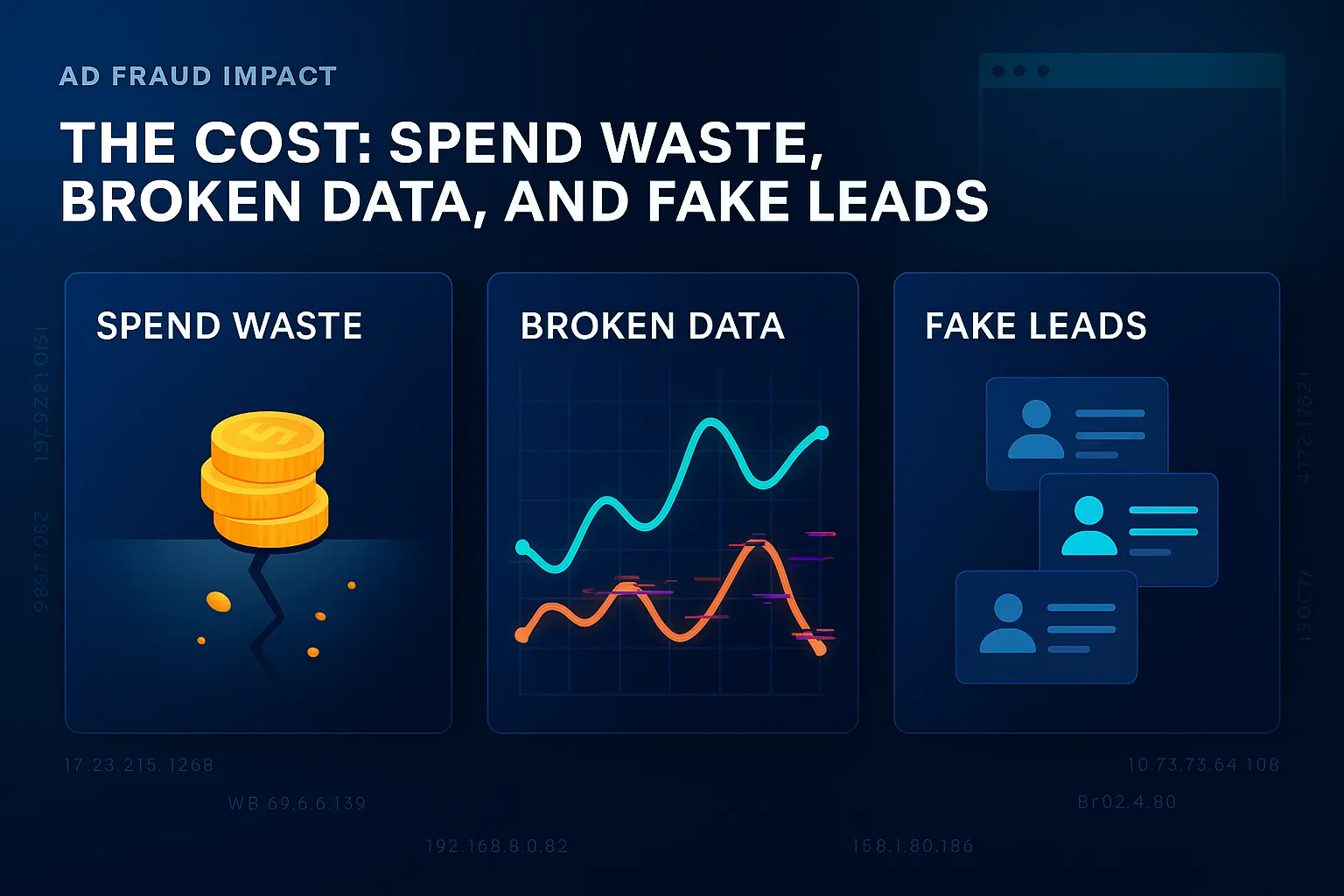
The cost: spend waste, broken data, and fake leads
Wasted spend: According to Spider AF's 2025 Ad Fraud White Paper, advertisers measured an average 5.1% fraud rate, with some companies seeing up to 51.8% of budget impacted before mitigation—translating to $37.7B in estimated global losses when applied to overall digital ad spend.
Lower true CVR: The same report shows valid clicks convert ~2x higher than invalid ones (2.54% vs. 1.29%), confirming that bot filtering isn’t just about “savings”—it’s a direct lever on pipeline quality.
Fake leads & CRM noise: Organic channels aren’t immune: Spider AF measured fake lead rates ~4.5x higher via organic (4.06%) than paid (0.91%), underscoring the need to protect all inbound, not only ads.
Market-wide risk backdrop: Bad bots now represent over a third of all internet traffic, increasing the baseline risk of automated abuse across every industry.
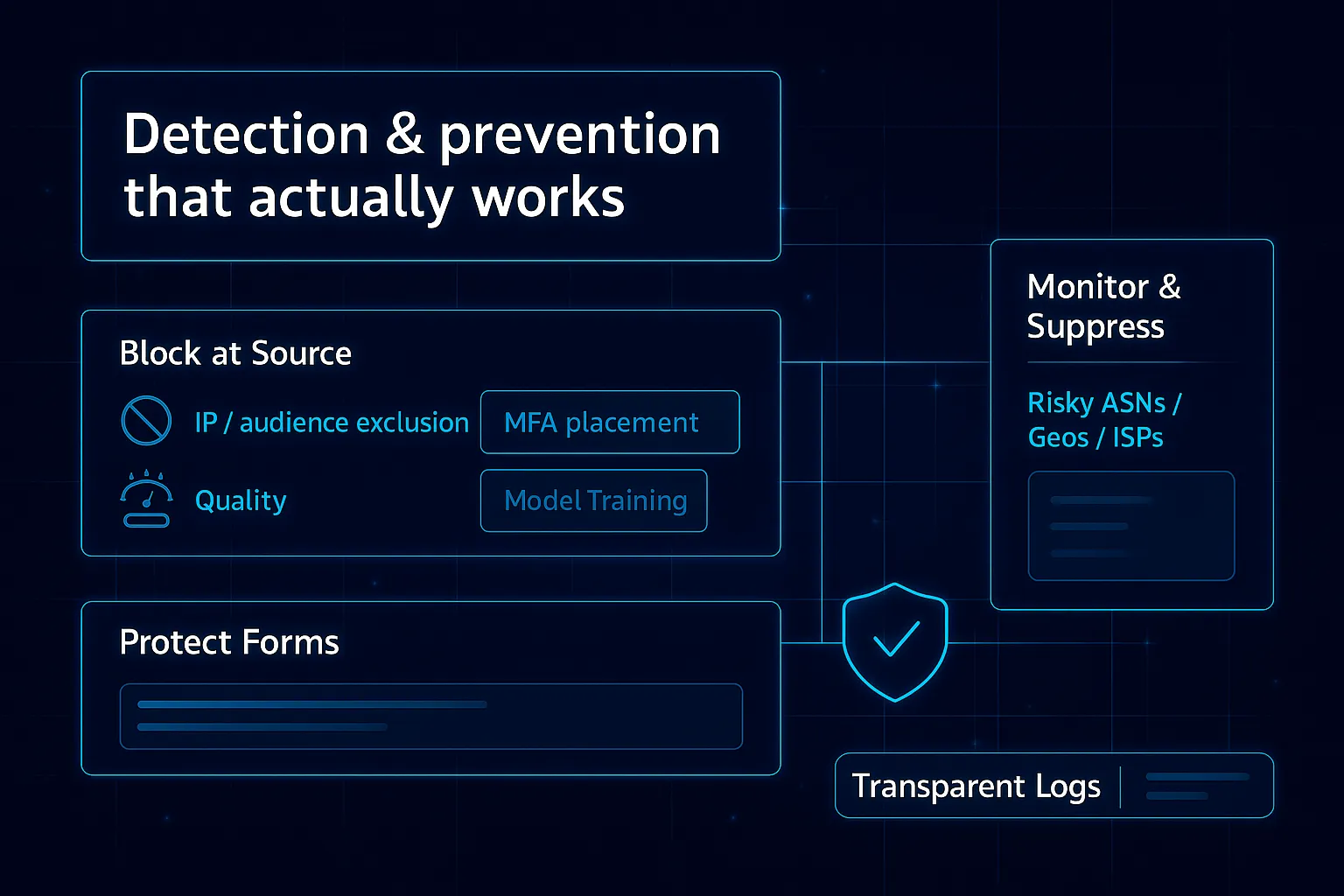
Detection & prevention that actually works
1) Block at the source (networks and placements)
Use an ad-verification layer that can score clicks in real-time and push IP/audience exclusions to ad networks, while also blocking poor placements (e.g., MFA categories) on display/P-Max. According to Spider AF’s Ad Fraud Protection documentation, Spider AF updates network blocklists hourly and supports Google via IP and audience exclusions and social platforms via audience exclusions, alongside automated MFA/brand-safety placement controls.
2) Score traffic quality and feed your algorithms clean data
Filtering bots is also an optimization strategy. By removing low-quality signals before they reach your bid models, you prevent the “garbage-in, garbage-out” loop. According to Spider AF's 2025 Ad Fraud White Paper, cleansing training data (e.g., excluding fraudulent conversions) improved ROI dramatically in measured case studies—one Search Partner scenario saw ROI up 152% and CPC down 85% after filtering.
Fraud bots increasingly target lead gen. Tie your click-level scoring to form submission verification so conversions from flagged entities get rejected or triaged before hitting CRM. Spider AF’s Fake Lead Protection integrates with CRMs to detect and automatically block fake conversions in real time.
4) Monitor & suppress bot-heavy geos, ISPs, and data centers
Keep an eye on anomalies like data-center ASN spikes, UA spoofing, and geo-mismatch. Automated rules should down-weight or block the riskiest cohorts. (Spider AF’s dashboards expose these dimensions for analysis and one-click suppression.)
5) Validate everything with transparent logs
If you can’t explain why a click was flagged, you can’t tune your risk tolerance. Choose tools that provide invalid click logs and campaign-level reporting so you can calibrate blocking without over-filtering.
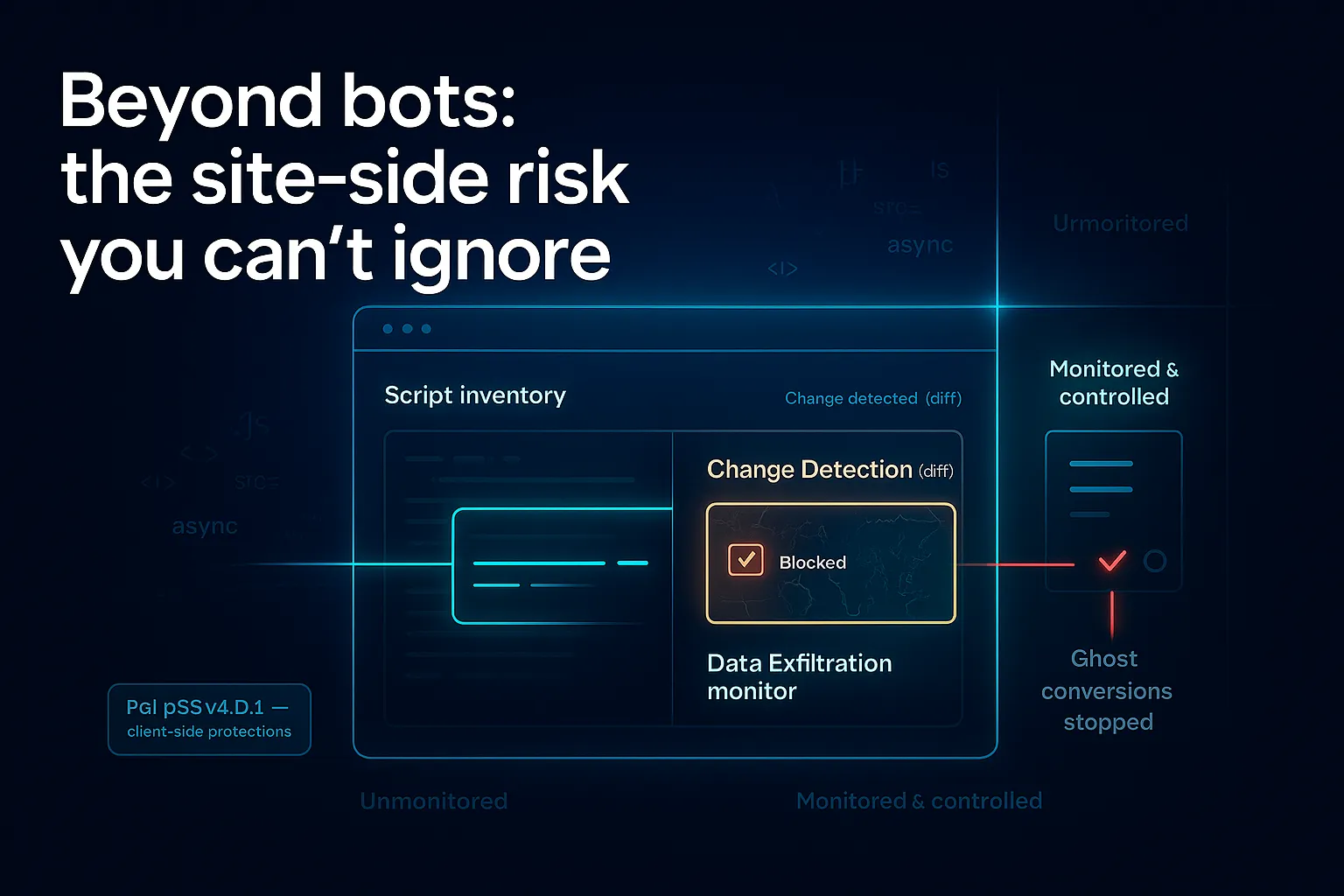
Beyond bots: the site-side risk you can’t ignore
Even if you purge bot clicks, client-side scripts (tags, third-party tools) can be tampered with to skim data or fake events—creating “ghost conversions” and compliance risk. PCI DSS v4.0.1 makes client-side protections mandatory by March 31, 2025, pushing marketers to monitor scripts, detect changes, and control data exfiltration. Spider AF SiteScan inventories scripts, flags anomalies, and tracks destinations so you can whitelist only what’s safe.
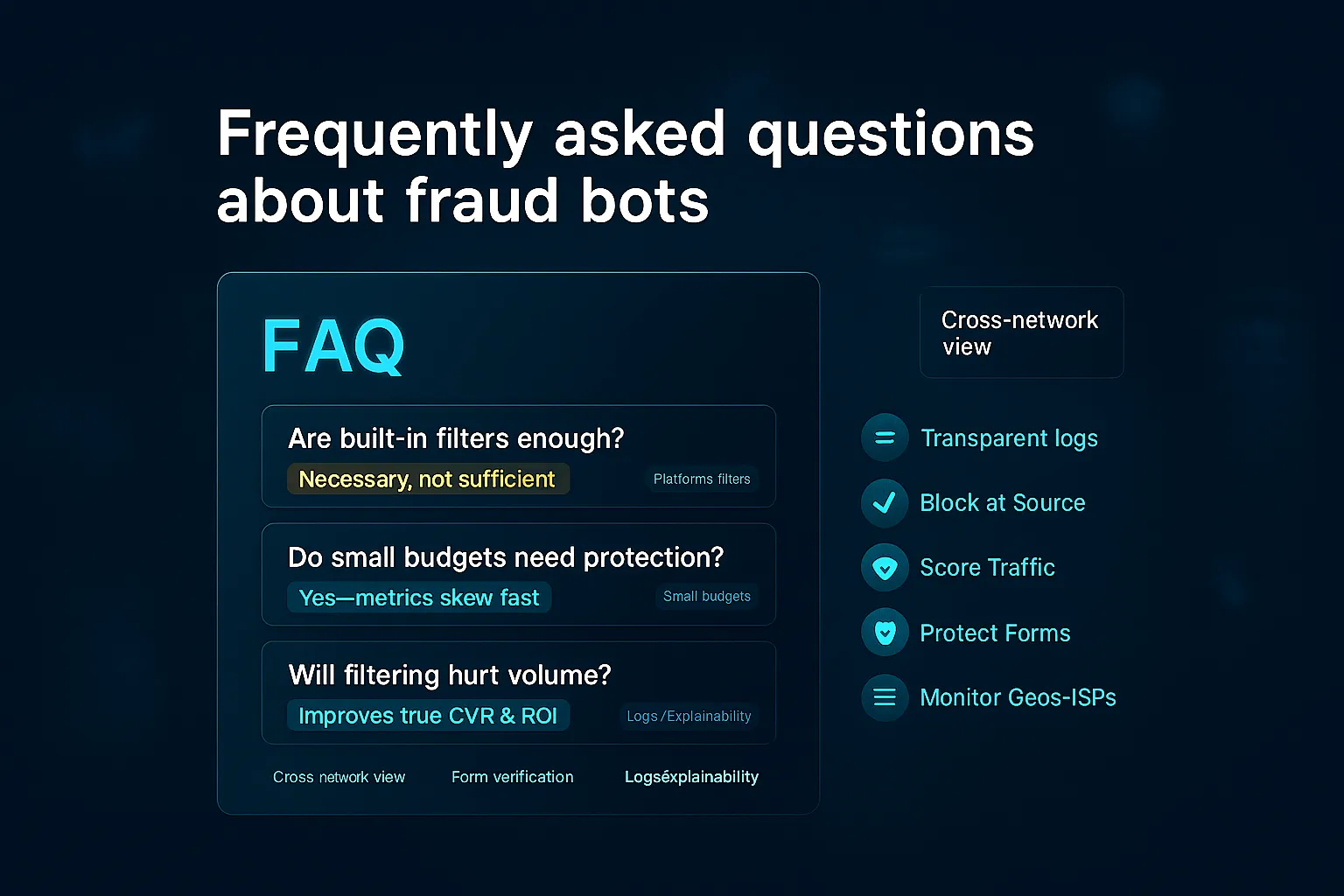
They’re necessary but not sufficient. Google publicly states that botnets can mimic real users, necessitating advanced detection beyond automated filters.Third-party protection adds cross-network visibility, placement controls, and CRM-level validation that platforms don’t provide by default.
Do small budgets need bot protection?
Yes—because a few hundred fake clicks can swing performance metrics, corrupt smart bidding, and flood sales with junk follow-ups. According to Spider AF's 2025 Ad Fraud White Paper, even “average” 5.1% fraud eats real budget and suppresses real CVR.
Is this only a programmatic display problem?
No. Bot activity and invalid clicks impact search, social, programmatic, and app ecosystems. Recent takedowns show mobile app-based fraud can drive billions of fake ad requests per day.
Conclusion: Clean traffic is the new growth lever
Fraud bots are not just a cost center—they’re a growth limiter. They waste spend, distort optimization, and pollute your pipeline. According to Spider AF's 2025 Ad Fraud White Paper, methodical bot and fake-lead suppression improves both ROI and true conversion rates by restoring signal quality.
Recommended next step:
Start a free trial of Spider AF PPC Protection to block invalid clicks and bad placements across Google/Meta/TikTok. → https://spideraf.com/ppc-protection