Spider AF /
Resources /
Articles /
Click fraud lawsuit: when to sue—and when to stop it at the source
No items found.
September 4, 2025

Click fraud lawsuit: when to sue—and when to stop it at the source

In this article

01
What is a click farm?
01
What is a click farm?
01
What is a click farm?
01
What is a click farm?
01
What is a click farm?
Quick take · 30-second version

Click fraud lawsuit: it’s a phrase most marketers hope they’ll never have to Google. But in 2024–2025, real cases made headlines, and many advertisers asked the same question: “Should we sue—or is there a faster way to recover losses and prevent them from happening again?” This guide explains what a click fraud lawsuit typically covers, what recent cases signal for advertisers, how to evaluate whether you have a claim, and why most brands pair legal options with always-on fraud prevention to protect spend and data quality.

According to Spider AF's 2025 Ad Fraud White Paper, the average ad fraud rate across performance ads was 5.1% in 2024, with estimated global losses of $37.7B—and some networks measuring invalid rates north of 46%.  Those numbers put real dollars on the line and help explain why litigation has become more visible. In March 2025, for example, Google agreed to a $100M settlement tied to legacy AdWords practices alleged to overcharge advertisers—particularly on location targeting and smart pricing—subject to court approval. And in January 2025, the U.S. Supreme Court allowed a multibillion-dollar class action to proceed against Meta over allegedly inflated “potential reach” metrics.

Still, lawsuits are slow, expensive, and uncertain. Most advertisers see the best results by tightening evidence collection (so they can pursue claims if needed) while immediately cutting off invalid traffic to protect ROI. Below, you’ll find a practical roadmap for both.

What legally counts as “click fraud”?

Click fraud generally refers to clicks (or impressions/conversions) intended to inflate costs or revenue rather than express real user interest—often by bots, malware, data centers, click farms, competitors, or mis-clicking placements. Platforms group this under “invalid traffic.”

Common legal theories when advertisers sue include:

  • Breach of contract / breach of the implied covenant (e.g., billing contrary to platform terms or the ad buy).
  • Statutory unfair competition / consumer protection (e.g., California B&PC §17200 prohibits “unlawful, unfair, or fraudulent” business acts).
  • Fraud/misrepresentation (if a party knowingly made false statements relied upon by the advertiser).
  • Unjust enrichment (retaining benefits from invalid clicks).

Courts have entertained various click-fraud-adjacent disputes over the years—ranging from challenges to how platforms screen invalid traffic to claims that metric definitions were misleading—though outcomes vary widely case-by-case.

This article is general information, not legal advice.

Click-fraud lawsuits to know (2024–2025)

  • Google Ads (legacy AdWords) settlement — $100M (proposed, Mar 2025): Allegations included billing for clicks outside targeted geographies and manipulating smart pricing. Google denied wrongdoing; the proposal awaits court approval.
  • Meta “inflated reach” class action — can proceed (Jan 2025): The Supreme Court declined to hear Meta’s appeal, allowing a class action over allegedly inflated “potential reach” numbers to go forward.
  • Other signals: The FTC’s enforcement activity around online deception and “AI-supercharged” schemes shows growing scrutiny of digital marketing abuses (not strictly click fraud, but relevant context for regulators’ posture).

Takeaway: You can see recovery via litigation or settlements—but these matters take years. Parallel operational protection is essential to stop current losses.
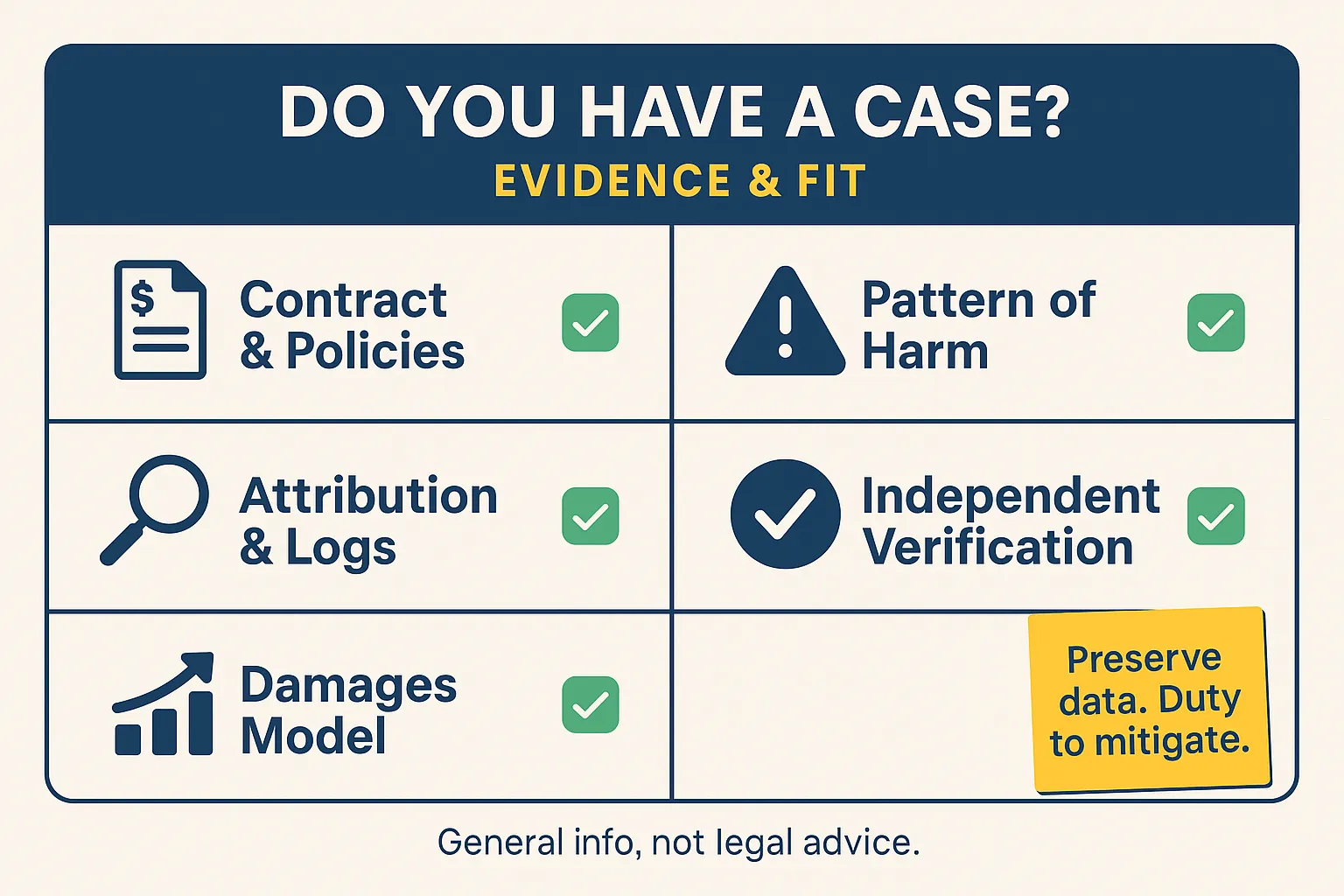
Do you have a case? A practical checklist

Use this to assess viability and strengthen day-one evidence:

  1. Contract & policy fit
    • Preserve the platform’s terms, ad buy insertion orders, and billing policies in effect during the disputed period. Statutory consumer-protection claims (e.g., California §17200) may also apply depending on facts and jurisdiction.
  2. Pattern of harm
    • Show a spike in invalid signals: impossible geo, abnormal UA strings, data-center IPs, bot patterns, overnight click bursts, or placements known for mis-clicking/MFA.
  3. Attribution & logs
    • Export raw click logs, IPs, user agents, timestamps, referrers, campaign/placement IDs, and any platform-reported “invalid” adjustments or credits.
  4. Independent verification
    • Third-party detection strengthens claims and remediation. According to Spider AF's 2025 Ad Fraud White Paper, invalid clicks break down across categories like click spamming, data-center traffic, bots, and spoofed UAs—use this taxonomy to label evidence consistently.
  5. Damages model
    • Tie invalid activity to spend, lost opportunities, and dirty optimization data (e.g., auto-bidding trained on fake signals).

Tip: Even if you pursue a claim, most counsel will advise you to mitigate ongoing losses immediately (duty to mitigate).
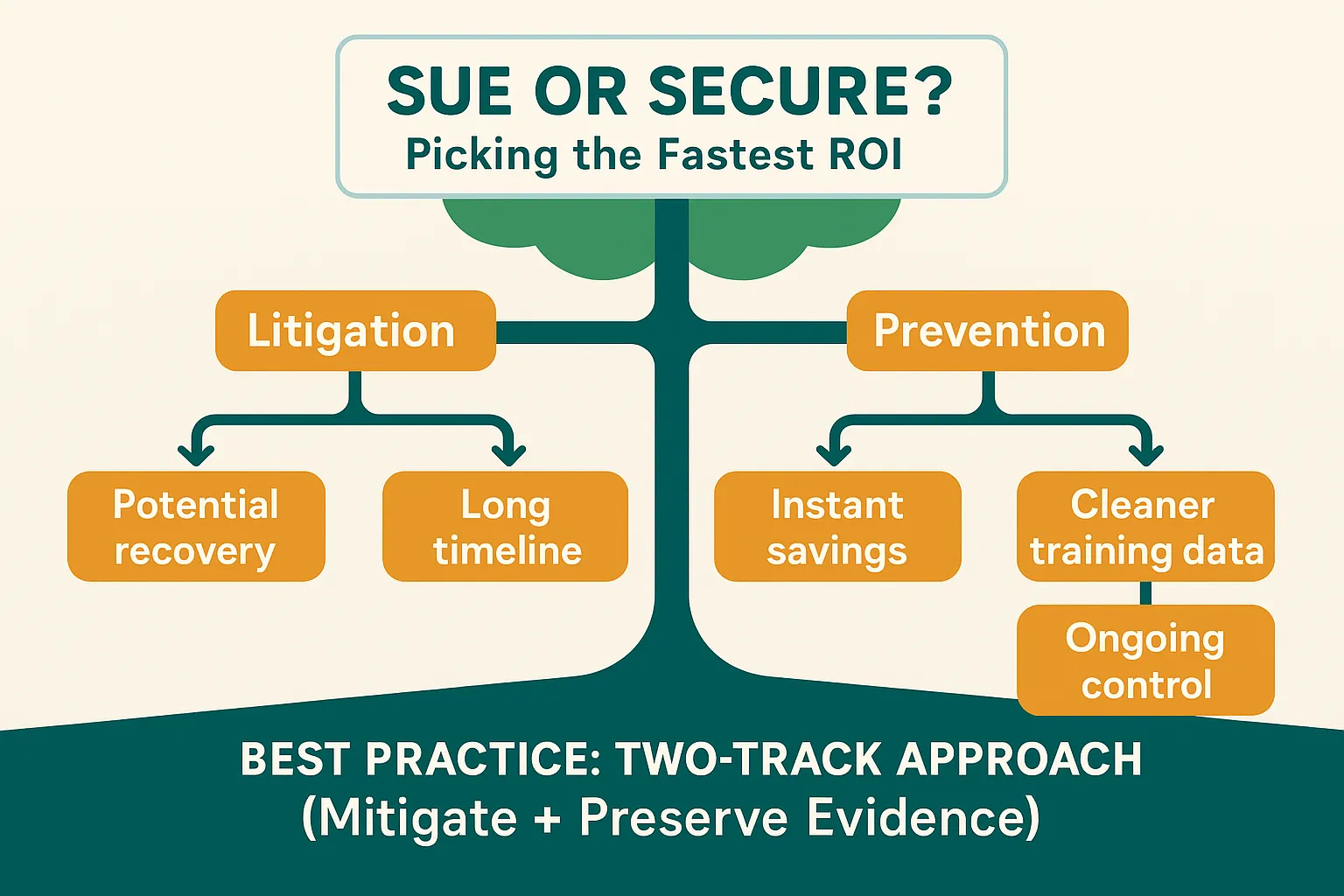
Cost–benefit: sue or secure?

Litigation is sometimes warranted (especially for systemic misrepresentations), but for most marketers the fastest ROI comes from better prevention:

  • Fraud is persistent: Average invalid rate of 5.1% in 2024; some networks exceeded 46% during Spider AF trials.
  • Fake leads hurt twice: They waste budget and poison machine-learning. In a documented case, Spider AF’s Fake Lead Protection led to a 152% ROI lift and 85% CPC reduction after filtering fraudulent conversions, without sacrificing valid leads.

Bottom line: Keep legal options open—but stop the bleeding now.

How to reduce legal and financial exposure today

1) Block invalid clicks and poor placements automatically

Spider AF’s PPC Protection monitors traffic in real time and pushes hourly blocklists to ad platforms. It performs IP and audience exclusions (e.g., Google Ads via IP/audience; social via audience), and flags/removes risky placements—including PMax/MFA and non-brand-safe categories—to keep optimization data clean.

2) Eliminate fake leads at the source

Fraudulent conversions drain sales teams and distort CPA. Spider AF’s Fake Lead Protection validates leads in real time (via CRM/JavaScript integration) and blocks fraudulent conversions before they pollute training data—improving CPL and pipeline quality. According to Spider AF's 2025 Ad Fraud White Paper, fake lead risks are rising, with organic channels showing ~4.5× higher fake lead rates than paid in one dataset—underscoring the need for cross-channel protection.

3) Secure client-side tags to reduce compliance risk

Client-side script tampering and third-party tags can cause unauthorized data transmissions and regulatory exposure (PCI DSS v4.0.1, GDPR, etc.). SiteScan inventories scripts, detects changes and exfiltration in real time, and provides dashboards and alerts—reducing the risk of fines, brand damage, and litigation tied to site-side data leaks.
Frequently asked questions

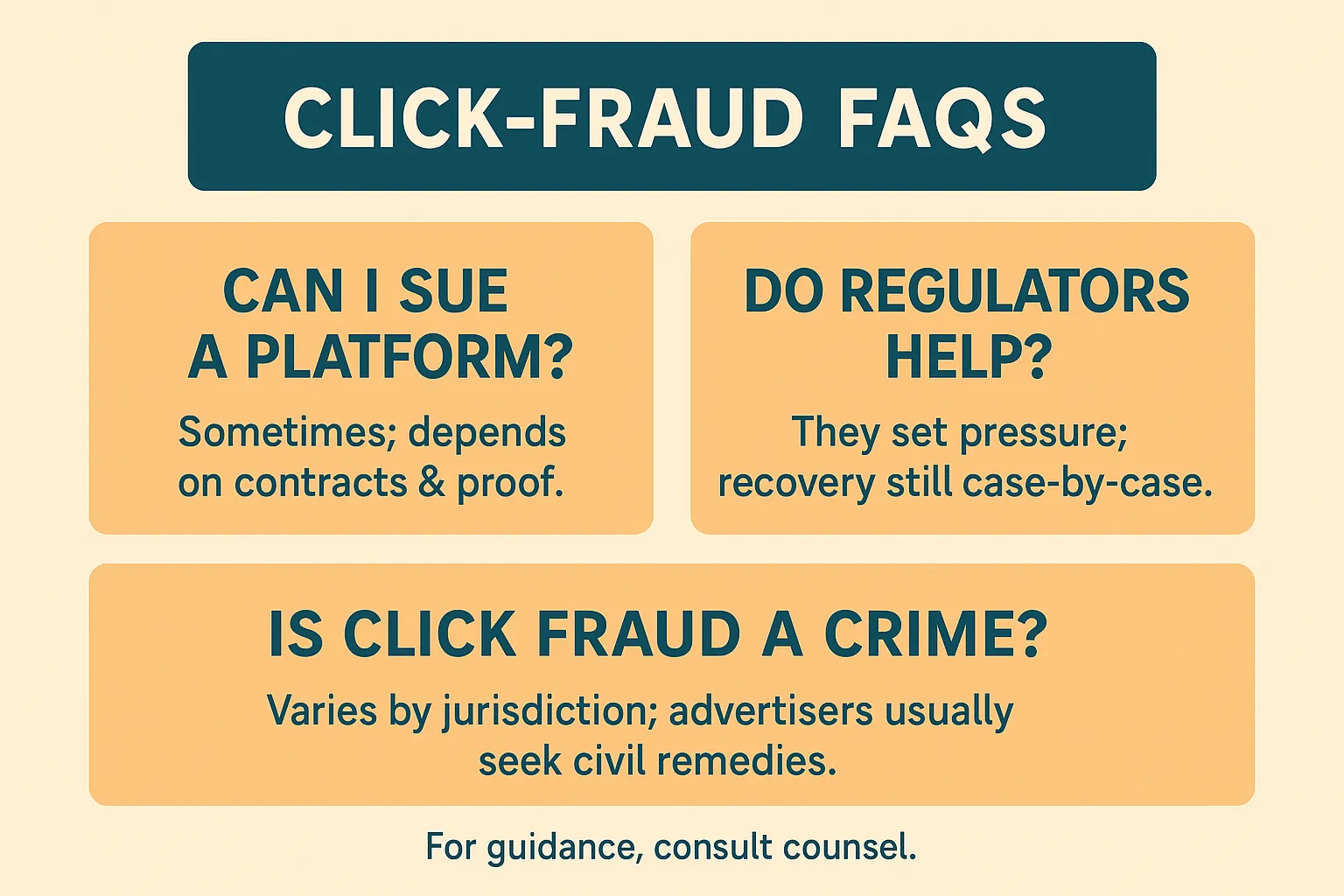
Can I sue a platform (or publisher) for click fraud?

Possibly—depending on contracts, representations, and your evidence. Recent matters show that class actions can proceed and even settle, but timelines are long.

If regulators act, does that help my case?

Regulatory scrutiny can clarify standards and pressure the ecosystem, but individual recovery usually still requires private claims or settlement eligibility.

Is click fraud a crime?

In some jurisdictions, automated click schemes can implicate computer misuse or fraud statutes, but advertisers typically proceed civilly for damages and injunctive relief.
Conclusion

If you suspect click fraud, protect budget now while you evaluate legal options. For many brands, a two-track approach works best: build a strong evidence file in case litigation makes sense, and deploy automation to cut invalid clicks and fake leads immediately.

Try Spider AF free and see the impact on spend and lead quality.

FREE SCAN

See your account's invalid traffic in 24 hours.

Spider AF will quantify exactly how much of your last 30 days of paid spend went to bots and click farms.

No credit card
1-line install
Cancel any time
Or book a 20-min demo
FAQ

People also ask.

Q 01 Are click farms illegal? +
In most jurisdictions, click farms violate ad-network terms of service and consumer-protection laws — but enforcement is patchy and cross-border. The FTC has taken action against fake-engagement operations, and Japan's METI has issued guidance treating fake reviews and bot traffic as deceptive practices. The practical reality: legal action is slow; technical blocking is fast.
Q 02 How is a click farm different from a botnet? +
Click farms typically use real humans (or human-supervised devices) to evade behavioral detection — they pass CAPTCHAs, mimic mouse movement, even simulate purchase journeys. Botnets are fully automated and easier to fingerprint. Modern fraud usually blends both: bots for volume, human "supervisors" for the high-value clicks.
Q 03 Can Google Ads or Meta detect click farms on their own? +
Both networks credit obviously-invalid clicks, but their detection runs on aggregated, post-hoc statistical signals — they refund days or weeks later. By then, your bidding algorithms have already optimized toward the polluted data. Independent, real-time detection at the click layer is what closes the loop.
Q 04 Will blocking click-farm traffic hurt my reach? +
No. Blocking invalid clicks only removes traffic that was never going to convert. The downstream effect is usually the opposite — your bidding model gets cleaner training signal and starts spending more on audiences that actually convert.
Q 05 How fast can Spider AF block click-farm traffic? +
Sub-200ms detection at the click event, with auto-sync to Google, Meta, TikTok, and Microsoft exclusion lists in seconds. Most accounts see meaningful blocking within 24 hours of installing the tag.

Click fraud lawsuit: when to sue—and when to stop it at the source

Table of Contents

Click fraud lawsuit: it’s a phrase most marketers hope they’ll never have to Google. But in 2024–2025, real cases made headlines, and many advertisers asked the same question: “Should we sue—or is there a faster way to recover losses and prevent them from happening again?” This guide explains what a click fraud lawsuit typically covers, what recent cases signal for advertisers, how to evaluate whether you have a claim, and why most brands pair legal options with always-on fraud prevention to protect spend and data quality.

According to Spider AF's 2025 Ad Fraud White Paper, the average ad fraud rate across performance ads was 5.1% in 2024, with estimated global losses of $37.7B—and some networks measuring invalid rates north of 46%.  Those numbers put real dollars on the line and help explain why litigation has become more visible. In March 2025, for example, Google agreed to a $100M settlement tied to legacy AdWords practices alleged to overcharge advertisers—particularly on location targeting and smart pricing—subject to court approval. And in January 2025, the U.S. Supreme Court allowed a multibillion-dollar class action to proceed against Meta over allegedly inflated “potential reach” metrics.

Still, lawsuits are slow, expensive, and uncertain. Most advertisers see the best results by tightening evidence collection (so they can pursue claims if needed) while immediately cutting off invalid traffic to protect ROI. Below, you’ll find a practical roadmap for both.

What legally counts as “click fraud”?

Click fraud generally refers to clicks (or impressions/conversions) intended to inflate costs or revenue rather than express real user interest—often by bots, malware, data centers, click farms, competitors, or mis-clicking placements. Platforms group this under “invalid traffic.”

Common legal theories when advertisers sue include:

  • Breach of contract / breach of the implied covenant (e.g., billing contrary to platform terms or the ad buy).
  • Statutory unfair competition / consumer protection (e.g., California B&PC §17200 prohibits “unlawful, unfair, or fraudulent” business acts).
  • Fraud/misrepresentation (if a party knowingly made false statements relied upon by the advertiser).
  • Unjust enrichment (retaining benefits from invalid clicks).

Courts have entertained various click-fraud-adjacent disputes over the years—ranging from challenges to how platforms screen invalid traffic to claims that metric definitions were misleading—though outcomes vary widely case-by-case.

This article is general information, not legal advice.

Click-fraud lawsuits to know (2024–2025)

  • Google Ads (legacy AdWords) settlement — $100M (proposed, Mar 2025): Allegations included billing for clicks outside targeted geographies and manipulating smart pricing. Google denied wrongdoing; the proposal awaits court approval.
  • Meta “inflated reach” class action — can proceed (Jan 2025): The Supreme Court declined to hear Meta’s appeal, allowing a class action over allegedly inflated “potential reach” numbers to go forward.
  • Other signals: The FTC’s enforcement activity around online deception and “AI-supercharged” schemes shows growing scrutiny of digital marketing abuses (not strictly click fraud, but relevant context for regulators’ posture).

Takeaway: You can see recovery via litigation or settlements—but these matters take years. Parallel operational protection is essential to stop current losses.

Do you have a case? A practical checklist

Use this to assess viability and strengthen day-one evidence:

  1. Contract & policy fit
    • Preserve the platform’s terms, ad buy insertion orders, and billing policies in effect during the disputed period. Statutory consumer-protection claims (e.g., California §17200) may also apply depending on facts and jurisdiction.
  2. Pattern of harm
    • Show a spike in invalid signals: impossible geo, abnormal UA strings, data-center IPs, bot patterns, overnight click bursts, or placements known for mis-clicking/MFA.
  3. Attribution & logs
    • Export raw click logs, IPs, user agents, timestamps, referrers, campaign/placement IDs, and any platform-reported “invalid” adjustments or credits.
  4. Independent verification
    • Third-party detection strengthens claims and remediation. According to Spider AF's 2025 Ad Fraud White Paper, invalid clicks break down across categories like click spamming, data-center traffic, bots, and spoofed UAs—use this taxonomy to label evidence consistently.
  5. Damages model
    • Tie invalid activity to spend, lost opportunities, and dirty optimization data (e.g., auto-bidding trained on fake signals).

Tip: Even if you pursue a claim, most counsel will advise you to mitigate ongoing losses immediately (duty to mitigate).

Cost–benefit: sue or secure?

Litigation is sometimes warranted (especially for systemic misrepresentations), but for most marketers the fastest ROI comes from better prevention:

  • Fraud is persistent: Average invalid rate of 5.1% in 2024; some networks exceeded 46% during Spider AF trials.
  • Fake leads hurt twice: They waste budget and poison machine-learning. In a documented case, Spider AF’s Fake Lead Protection led to a 152% ROI lift and 85% CPC reduction after filtering fraudulent conversions, without sacrificing valid leads.

Bottom line: Keep legal options open—but stop the bleeding now.

How to reduce legal and financial exposure today

1) Block invalid clicks and poor placements automatically

Spider AF’s PPC Protection monitors traffic in real time and pushes hourly blocklists to ad platforms. It performs IP and audience exclusions (e.g., Google Ads via IP/audience; social via audience), and flags/removes risky placements—including PMax/MFA and non-brand-safe categories—to keep optimization data clean.

2) Eliminate fake leads at the source

Fraudulent conversions drain sales teams and distort CPA. Spider AF’s Fake Lead Protection validates leads in real time (via CRM/JavaScript integration) and blocks fraudulent conversions before they pollute training data—improving CPL and pipeline quality. According to Spider AF's 2025 Ad Fraud White Paper, fake lead risks are rising, with organic channels showing ~4.5× higher fake lead rates than paid in one dataset—underscoring the need for cross-channel protection.

3) Secure client-side tags to reduce compliance risk

Client-side script tampering and third-party tags can cause unauthorized data transmissions and regulatory exposure (PCI DSS v4.0.1, GDPR, etc.). SiteScan inventories scripts, detects changes and exfiltration in real time, and provides dashboards and alerts—reducing the risk of fines, brand damage, and litigation tied to site-side data leaks.

Frequently asked questions

Can I sue a platform (or publisher) for click fraud?

Possibly—depending on contracts, representations, and your evidence. Recent matters show that class actions can proceed and even settle, but timelines are long.

If regulators act, does that help my case?

Regulatory scrutiny can clarify standards and pressure the ecosystem, but individual recovery usually still requires private claims or settlement eligibility.

Is click fraud a crime?

In some jurisdictions, automated click schemes can implicate computer misuse or fraud statutes, but advertisers typically proceed civilly for damages and injunctive relief.

Conclusion

If you suspect click fraud, protect budget now while you evaluate legal options. For many brands, a two-track approach works best: build a strong evidence file in case litigation makes sense, and deploy automation to cut invalid clicks and fake leads immediately.

Try Spider AF free and see the impact on spend and lead quality.

SpiderAF
アドフラウド
Spider Labs