Spider AF /
Resources /
Articles /
Click Bots Online: What They Are & How to Stop Them
Ad Fraud 101
RESEARCH
September 8, 2025

Click Bots Online: What They Are & How to Stop Them

In this article

01
What is a click farm?
01
What is a click farm?
01
What is a click farm?
01
What is a click farm?
01
What is a click farm?
Quick take · 30-second version

“Click bots” are automated programs that simulate human clicks on ads and links. They drain PPC budgets, pollute analytics, and mislead auto‑optimization systems into doubling down on the worst traffic. In 2024–2025, the problem escalated as attackers began to use AI to scale and disguise automated activity. Imperva’s 2025 Bad Bot Report notes that automated traffic surpassed human activity, accounting for 51% of all web traffic, with bad bots at 37%—a sharp reminder that much of what hits your site isn’t a person at all.

Platforms broadly classify these events as “invalid traffic.” Google defines invalid traffic as clicks and impressions that don’t come from genuine user interest, including fraudulent, accidental, and duplicate clicks. That means “click bots” are squarely in scope for refunds, filtering, and enforcement—but detection is imperfect, and advertisers still eat a lot of waste before platforms clamp down.

Why should marketers care now? First, AI‑driven bots are better at evading basic rules and device fingerprint checks. Second, algorithmic campaigns like Performance Max and social auto‑placements heavily rely on conversion signals. Feed them low‑quality clicks and fake conversions, and the machine learns the wrong lesson—pushing more budget into the same junk. Third, regulations such as the EU Digital Services Act keep tightening transparency expectations across platforms and intermediaries, putting more pressure on brands to verify traffic quality.

This guide explains how click bots work, how to recognize the damage in your metrics, and how to block them quickly. Where relevant, we share fresh benchmarks and real outcomes from Spider AF’s data to help you prioritize. According to Spider AF's 2025 Ad Fraud White Paper, the average ad fraud rate reached 5.1% in 2024 across measured web platforms, with some networks exceeding 46.9% fraudulent traffic. We will translate numbers like these into concrete steps you can use today.
What are click bots? Types and behavior

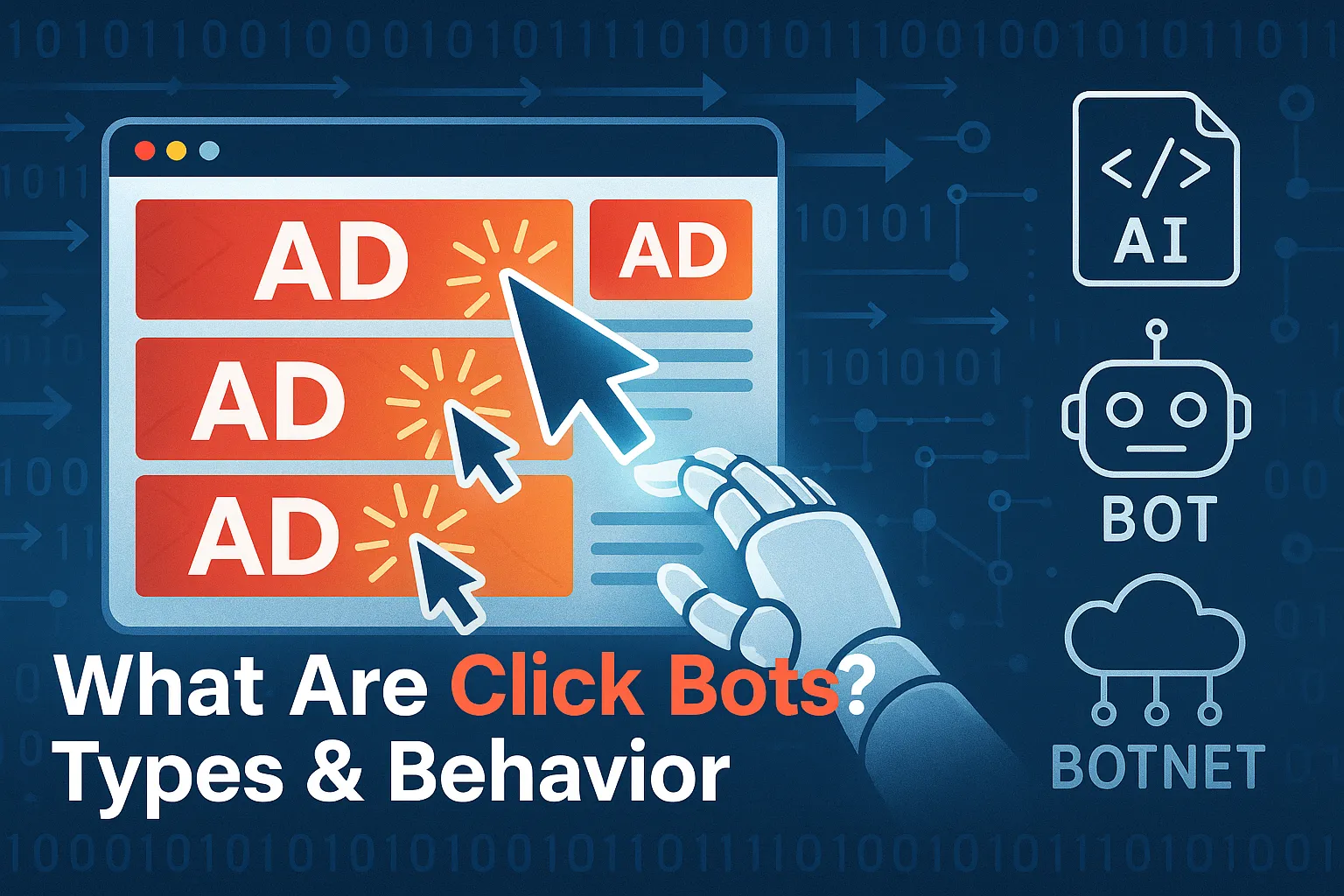
Click bots are automated scripts or headless browsers that click ads or links to inflate engagement or siphon budget. They can be simple (repeat clicks from data‑center IPs) or advanced (distributed residential proxies with randomized timing). Cloudflare classifies click‑driven ad fraud as a subset of ad fraud in which bots create fake clicks to generate revenue or drain competitors.

Industry standards refer to this broader problem as Invalid Traffic (IVT), with “General IVT” and “Sophisticated IVT” designations used in audits and measurement. The Media Rating Council’s IVT guidance underpins many ad verification programs. Practically, you’ll see artifacts like unnatural CTR spikes, very short dwell times, odd user agents, repetitive paths, and mismatched geo or language to campaign targeting.

Common signals in logs:

  • Repeated clicks from the same device fingerprint or IP ranges (often data centers).
  • Spoofed user agents and outdated browsers not matched to OS versions.
  • Anomalous geos or off‑target locales.
  • High “clicks per session” with near‑zero scroll, events, or conversions.
  • Night‑time surge patterns inconsistent with your audience.

How click bots kill ROI: the numbers

According to Spider AF's 2025 Ad Fraud White Paper, 5.1% of measured clicks were fraudulent on average in 2024, and in extreme cases up to 51.8% of a single company’s spend was impacted. The white paper estimates $37.7B in global annual losses when that rate is applied to worldwide digital ad spend.

Fraud doesn’t just waste money—it wrecks optimization. The same report shows conversion rates from valid clicks are roughly 2x higher than from invalid clicks (2.54% vs. 1.29% across 324 companies). That means filtering bots improves lead quality and the machine‑learning signals you feed into PMax, Advantage+ and other algorithmic systems.

Bots also pollute organic funnels. Spider AF found fake‑lead rates from organic channels around 4.06%, nearly 4.5x higher than paid ad conversions (0.91%) in the study cohort—so treating “free” traffic as safe is risky.

On the macro web, Imperva’s 2025 report underscores the scale: bad bots account for 37% of traffic, and automated traffic overall is 51%, raising the baseline odds that any visit could be automated.
How to detect click bots across Google Ads, PMax, and social

Start with platform signals (but don’t stop there)

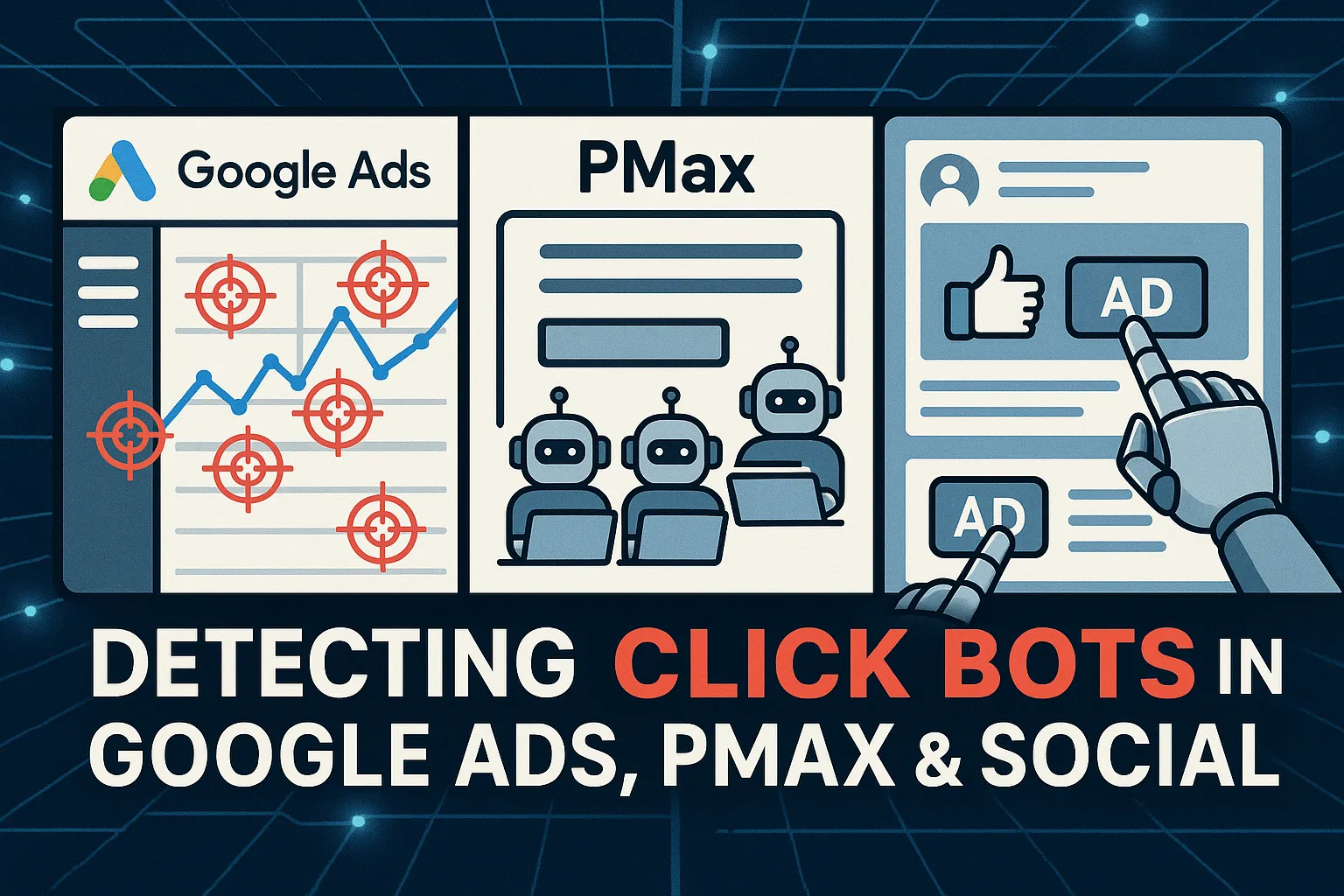
Google provides invalid‑traffic detection and credits when possible, but platform filters are not comprehensive and rarely tailored to your business risk. Treat platform IVT as a baseline, then layer independent detection to catch what slips through.

Tell‑tale patterns to monitor

  • CTR anomalies at the placement, publisher, or search‑partner level.
  • Zero‑engagement sessions: ≤1–2 seconds on page, no scroll, no events.
  • Data‑center IPs and spoofed user agents.
  • Geo drift or traffic from unmarketed countries.
  • PMax/Search Partner abuse: surges in cheap clicks and off‑target conversions that derail model training. Spider AF documents PMax optimization abuse and search‑partner spikes producing fake leads unless filtered.

Validate against industry standards

Use MRC IVT concepts to classify “General” vs “Sophisticated” IVT and set policies on what to block vs. review. This is useful for audits and agency conversations.
How to block and prevent click bots (step‑by‑step)

1) Turn on automated IP & audience exclusions

Spider AF PPC Protection installs a lightweight script and automatically excludes invalid users via IP and audience exclusions (Google) and audience exclusions (Meta), updating blocklists hourly. This captures data‑center traffic, click spamming, spoofed UAs, and known bot fingerprints before they click again.

2) Police placements and MFA sites

Display and PMax campaigns require hard placement hygiene. Spider AF auto‑detects and blocks MFA (Made‑for‑Advertising), ad clutter, collision, and non‑brand‑safe categories, then surfaces manual block candidates with performance metrics. This alone can stabilize CPC and ROAS on PMax.

3) Protect your CRM from fake leads

Click bots often evolve into form bots. Spider AF’s Fake Lead Protection verifies conversions in real time with CRM integration, preventing bad records from training your bid strategies. In documented cases, removing fraudulent leads increased ROI and dropped CPC without hurting valid conversions. According to Spider AF's 2025 Ad Fraud White Paper, one deployment delivered ROI up 152% and CPC down 85% after filtering fake leads.

4) Lock down client‑side scripts (supply‑chain risk)

If attackers abuse Tag Manager or third‑party scripts, they can inject form‑stealing or click‑simulation code. Spider AF SiteScan inventories every client‑side script, flags risky destinations, and alerts on tampering—aligned with PCI DSS v4.0.1 client‑side security mandates taking full effect March 31, 2025.

5) Report and reconcile

Use independent logs to challenge ad networks when IVT spikes and to share third‑party thresholds with agencies and leadership. The Spider AF dashboard exposes invalid‑click logs and exportable reports so you can quantify savings and tune policies.
FAQ: common questions about click bots online

Are click bots illegal?

They can be, depending on jurisdiction and intent (fraud, unauthorized access). Platforms ban them; regulations increasingly require ad transparency and due care by platforms and advertisers (see the EU DSA).

Do platforms refund all bot clicks?

No. Google and others filter proactively and may credit after review, but many invalid clicks evade platform filters. Independent protection reduces waste before credits occur.

Can “organic” bots hurt me?

Yes. Fake leads and scripted sign‑ups from organic sources corrupt CRM data and automated bidding if they’re used as optimization signals. Spider AF observed organic fake‑lead rates around 4.06%, ~4.5x paid‑ad conversions.

How fast can I see impact after blocking?

Typically within days: CPC normalizes, CTR stabilizes, and CVR rises as cleaner traffic trains the algorithm. Case studies inside Spider AF’s materials show large spend savings after blocking thousands of invalid clicks.
Conclusion: stop click bots before they train your ads

AI‑driven bots now account for a significant share of the web. Relying on platform‑only filters is not enough. The smartest move is to combine automated blocking, strict placement control, CRM‑level lead verification, and script monitoring.

Try Spider AF with a free trial and see the savings in your own logs.

FREE SCAN

See your account's invalid traffic in 24 hours.

Spider AF will quantify exactly how much of your last 30 days of paid spend went to bots and click farms.

No credit card
1-line install
Cancel any time
Or book a 20-min demo
FAQ

People also ask.

Q 01 Are click farms illegal? +
In most jurisdictions, click farms violate ad-network terms of service and consumer-protection laws — but enforcement is patchy and cross-border. The FTC has taken action against fake-engagement operations, and Japan's METI has issued guidance treating fake reviews and bot traffic as deceptive practices. The practical reality: legal action is slow; technical blocking is fast.
Q 02 How is a click farm different from a botnet? +
Click farms typically use real humans (or human-supervised devices) to evade behavioral detection — they pass CAPTCHAs, mimic mouse movement, even simulate purchase journeys. Botnets are fully automated and easier to fingerprint. Modern fraud usually blends both: bots for volume, human "supervisors" for the high-value clicks.
Q 03 Can Google Ads or Meta detect click farms on their own? +
Both networks credit obviously-invalid clicks, but their detection runs on aggregated, post-hoc statistical signals — they refund days or weeks later. By then, your bidding algorithms have already optimized toward the polluted data. Independent, real-time detection at the click layer is what closes the loop.
Q 04 Will blocking click-farm traffic hurt my reach? +
No. Blocking invalid clicks only removes traffic that was never going to convert. The downstream effect is usually the opposite — your bidding model gets cleaner training signal and starts spending more on audiences that actually convert.
Q 05 How fast can Spider AF block click-farm traffic? +
Sub-200ms detection at the click event, with auto-sync to Google, Meta, TikTok, and Microsoft exclusion lists in seconds. Most accounts see meaningful blocking within 24 hours of installing the tag.

Click Bots Online: What They Are & How to Stop Them

Table of Contents

“Click bots” are automated programs that simulate human clicks on ads and links. They drain PPC budgets, pollute analytics, and mislead auto‑optimization systems into doubling down on the worst traffic. In 2024–2025, the problem escalated as attackers began to use AI to scale and disguise automated activity. Imperva’s 2025 Bad Bot Report notes that automated traffic surpassed human activity, accounting for 51% of all web traffic, with bad bots at 37%—a sharp reminder that much of what hits your site isn’t a person at all.

Platforms broadly classify these events as “invalid traffic.” Google defines invalid traffic as clicks and impressions that don’t come from genuine user interest, including fraudulent, accidental, and duplicate clicks. That means “click bots” are squarely in scope for refunds, filtering, and enforcement—but detection is imperfect, and advertisers still eat a lot of waste before platforms clamp down.

Why should marketers care now? First, AI‑driven bots are better at evading basic rules and device fingerprint checks. Second, algorithmic campaigns like Performance Max and social auto‑placements heavily rely on conversion signals. Feed them low‑quality clicks and fake conversions, and the machine learns the wrong lesson—pushing more budget into the same junk. Third, regulations such as the EU Digital Services Act keep tightening transparency expectations across platforms and intermediaries, putting more pressure on brands to verify traffic quality.

This guide explains how click bots work, how to recognize the damage in your metrics, and how to block them quickly. Where relevant, we share fresh benchmarks and real outcomes from Spider AF’s data to help you prioritize. According to Spider AF's 2025 Ad Fraud White Paper, the average ad fraud rate reached 5.1% in 2024 across measured web platforms, with some networks exceeding 46.9% fraudulent traffic. We will translate numbers like these into concrete steps you can use today.

What are click bots? Types and behavior

Click bots are automated scripts or headless browsers that click ads or links to inflate engagement or siphon budget. They can be simple (repeat clicks from data‑center IPs) or advanced (distributed residential proxies with randomized timing). Cloudflare classifies click‑driven ad fraud as a subset of ad fraud in which bots create fake clicks to generate revenue or drain competitors.

Industry standards refer to this broader problem as Invalid Traffic (IVT), with “General IVT” and “Sophisticated IVT” designations used in audits and measurement. The Media Rating Council’s IVT guidance underpins many ad verification programs. Practically, you’ll see artifacts like unnatural CTR spikes, very short dwell times, odd user agents, repetitive paths, and mismatched geo or language to campaign targeting.

Common signals in logs:

  • Repeated clicks from the same device fingerprint or IP ranges (often data centers).
  • Spoofed user agents and outdated browsers not matched to OS versions.
  • Anomalous geos or off‑target locales.
  • High “clicks per session” with near‑zero scroll, events, or conversions.
  • Night‑time surge patterns inconsistent with your audience.

How click bots kill ROI: the numbers

According to Spider AF's 2025 Ad Fraud White Paper, 5.1% of measured clicks were fraudulent on average in 2024, and in extreme cases up to 51.8% of a single company’s spend was impacted. The white paper estimates $37.7B in global annual losses when that rate is applied to worldwide digital ad spend.

Fraud doesn’t just waste money—it wrecks optimization. The same report shows conversion rates from valid clicks are roughly 2x higher than from invalid clicks (2.54% vs. 1.29% across 324 companies). That means filtering bots improves lead quality and the machine‑learning signals you feed into PMax, Advantage+ and other algorithmic systems.

Bots also pollute organic funnels. Spider AF found fake‑lead rates from organic channels around 4.06%, nearly 4.5x higher than paid ad conversions (0.91%) in the study cohort—so treating “free” traffic as safe is risky.

On the macro web, Imperva’s 2025 report underscores the scale: bad bots account for 37% of traffic, and automated traffic overall is 51%, raising the baseline odds that any visit could be automated.

How to detect click bots across Google Ads, PMax, and social

Start with platform signals (but don’t stop there)

Google provides invalid‑traffic detection and credits when possible, but platform filters are not comprehensive and rarely tailored to your business risk. Treat platform IVT as a baseline, then layer independent detection to catch what slips through.

Tell‑tale patterns to monitor

  • CTR anomalies at the placement, publisher, or search‑partner level.
  • Zero‑engagement sessions: ≤1–2 seconds on page, no scroll, no events.
  • Data‑center IPs and spoofed user agents.
  • Geo drift or traffic from unmarketed countries.
  • PMax/Search Partner abuse: surges in cheap clicks and off‑target conversions that derail model training. Spider AF documents PMax optimization abuse and search‑partner spikes producing fake leads unless filtered.

Validate against industry standards

Use MRC IVT concepts to classify “General” vs “Sophisticated” IVT and set policies on what to block vs. review. This is useful for audits and agency conversations.

How to block and prevent click bots (step‑by‑step)

1) Turn on automated IP & audience exclusions

Spider AF PPC Protection installs a lightweight script and automatically excludes invalid users via IP and audience exclusions (Google) and audience exclusions (Meta), updating blocklists hourly. This captures data‑center traffic, click spamming, spoofed UAs, and known bot fingerprints before they click again.

2) Police placements and MFA sites

Display and PMax campaigns require hard placement hygiene. Spider AF auto‑detects and blocks MFA (Made‑for‑Advertising), ad clutter, collision, and non‑brand‑safe categories, then surfaces manual block candidates with performance metrics. This alone can stabilize CPC and ROAS on PMax.

3) Protect your CRM from fake leads

Click bots often evolve into form bots. Spider AF’s Fake Lead Protection verifies conversions in real time with CRM integration, preventing bad records from training your bid strategies. In documented cases, removing fraudulent leads increased ROI and dropped CPC without hurting valid conversions. According to Spider AF's 2025 Ad Fraud White Paper, one deployment delivered ROI up 152% and CPC down 85% after filtering fake leads.

4) Lock down client‑side scripts (supply‑chain risk)

If attackers abuse Tag Manager or third‑party scripts, they can inject form‑stealing or click‑simulation code. Spider AF SiteScan inventories every client‑side script, flags risky destinations, and alerts on tampering—aligned with PCI DSS v4.0.1 client‑side security mandates taking full effect March 31, 2025.

5) Report and reconcile

Use independent logs to challenge ad networks when IVT spikes and to share third‑party thresholds with agencies and leadership. The Spider AF dashboard exposes invalid‑click logs and exportable reports so you can quantify savings and tune policies.

FAQ: common questions about click bots online

Are click bots illegal?

They can be, depending on jurisdiction and intent (fraud, unauthorized access). Platforms ban them; regulations increasingly require ad transparency and due care by platforms and advertisers (see the EU DSA).

Do platforms refund all bot clicks?

No. Google and others filter proactively and may credit after review, but many invalid clicks evade platform filters. Independent protection reduces waste before credits occur.

Can “organic” bots hurt me?

Yes. Fake leads and scripted sign‑ups from organic sources corrupt CRM data and automated bidding if they’re used as optimization signals. Spider AF observed organic fake‑lead rates around 4.06%, ~4.5x paid‑ad conversions.

How fast can I see impact after blocking?

Typically within days: CPC normalizes, CTR stabilizes, and CVR rises as cleaner traffic trains the algorithm. Case studies inside Spider AF’s materials show large spend savings after blocking thousands of invalid clicks.

Conclusion: stop click bots before they train your ads

AI‑driven bots now account for a significant share of the web. Relying on platform‑only filters is not enough. The smartest move is to combine automated blocking, strict placement control, CRM‑level lead verification, and script monitoring.

Try Spider AF with a free trial and see the savings in your own logs.

SpiderAF
アドフラウド
Spider Labs